Trading activity is accelerating across every major financial market, such as forex and crypto, which drives the growing demand for speed and automation. This huge adoption of algorithmic trading technologies is fueling the significant expansion in the global High-Frequency Trading (HFT) industry. According to the recent Market Growth Reports, the global high-frequency trading market is estimated to exceed $27 billion by 2035, driven by increasing demand for faster trade execution with low-latency infrastructure and artificial intelligence-powered trading strategies.
Organizations are now investing heavily in HFT technologies to capitalize on market inefficiencies to transforming how trading decisions are made. As competition intensifies and execution speed becomes a key differentiator, understanding how HFT trading bots operate has become most important for businesses looking to participate in today's fast-moving financial ecosystem. In this guide, you will get everything you need to know about High-Frequency Trading (HFT) bots.
What Is an HFT Bot?
A High Frequency Trading (HFT) Bot is an advanced automated trading system designed to execute a large number of trades within fractions of a second using sophisticated algorithms and low-latency infrastructure. The primary objective of an HFT bot is to capitalize on small price movements and market inefficiencies across different exchanges, brokers, liquidity providers, or markets that may exist for only milliseconds. To achieve this, HFT trading bots leverage advanced algorithms, ultra-low-latency networks, and powerful computing systems capable of processing vast amounts of market data in real time.
HFT trading bots are widely used across cryptocurrency, forex, and stock markets. Financial institutions, hedge funds, proprietary trading firms, and professional traders rely on these bots to gain a competitive advantage in fast-moving markets. While speed is a defining characteristic of HFT trading bots, their effectiveness also depends on intelligent trading strategies, robust infrastructure, real-time market analysis, and advanced risk management mechanisms.
How Does an HFT Trading Bot Work?
An HFT trading bot operates through a highly automated process that regularly monitors market conditions, identifies trading opportunities, and executes orders in real time. Unlike conventional trading systems that may rely on manual intervention. From collecting market information to monitoring active positions, every stage plays a critical role in the bot's overall performance.
Step 1: Market Data Collection
The process begins with collecting real-time market data from exchanges, brokers, & liquidity providers. The bot continuously gathers information such as asset prices, historical market patterns, and more. This data serves as the foundation for all trading decisions and is processed with minimal delay to maintain a competitive advantage.
Step 2: Real-Time Analysis
Once market data is collected, the HFT bot analyzes the data with predefined strategies. During this stage, the bot evaluates market conditions, identifies trends, measures volatility, & detects potential trading signals. The help the bot to process vast amounts of data in real time allows HFT bots to react faster.
Step 3: Opportunity Detection
After analyzing the market conditions, the bot searches for profitable trading opportunities based on the bot's configured strategy. These opportunities may include arbitrage situations, market-making opportunities, or even short-term market inefficiencies.
Step 4: Automated Execution
Once the opportunity is identified, the bot will automatically place the order through the connected exchanges and brokerage platforms. With advanced order execution mechanisms, bots ensure the trade is executed at the desired price with low to no slippage and execution delay.
Step 5: Risk Monitoring
Risk management remains very active throughout the entire trading process. The bot continuously monitors the market conditions to ensure that trading activity remains within predefined risk parameters. If unusual market behavior is detected, the system automatically adjusts positions or halts trading activities to protect capital.
By continuously repeating this cycle thousands of times per day, HFT trading bots can identify and execute profitable opportunities at a scale and speed that would be impossible through manual trading.
HFT Trading Bot Architecture
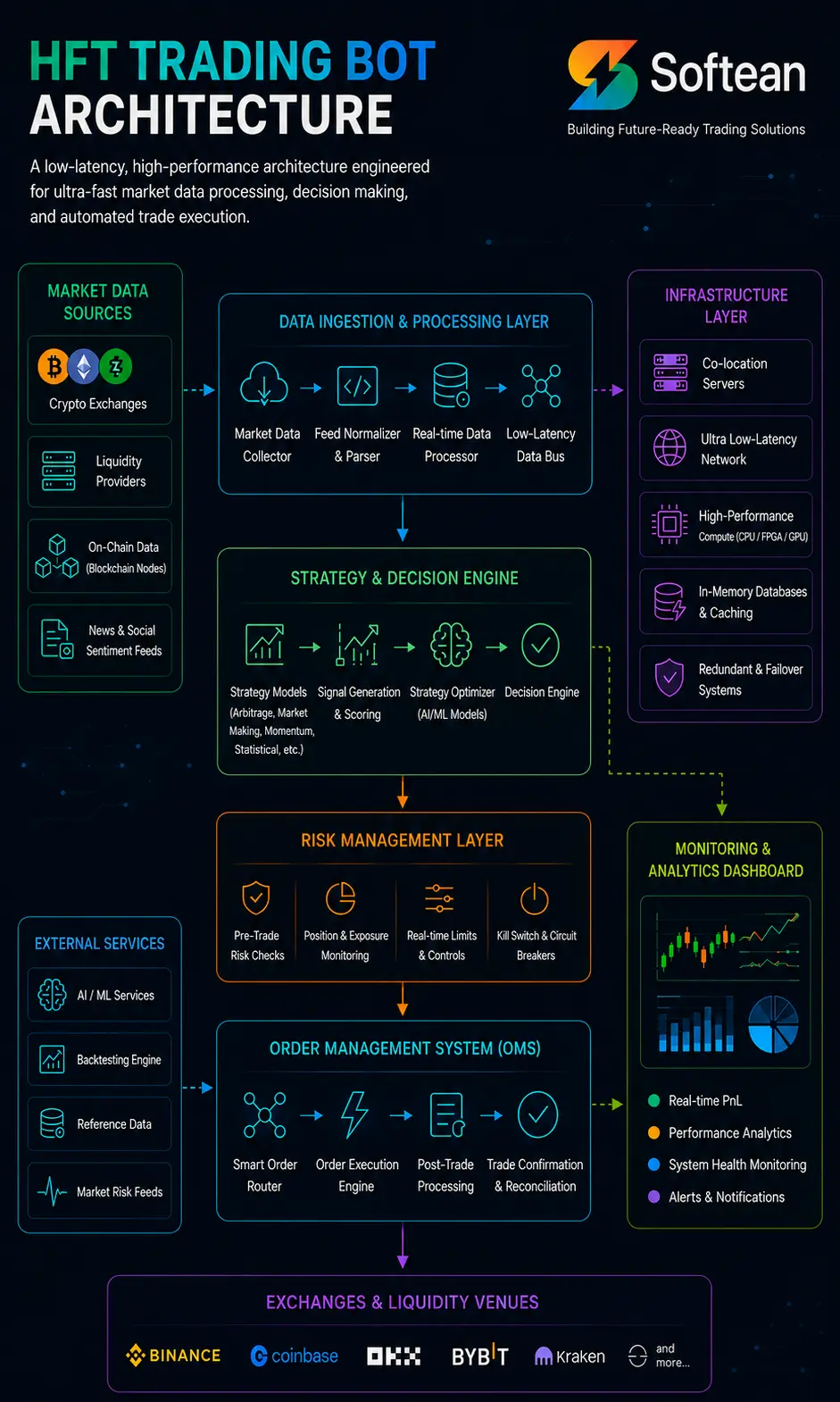
Each layer of the architecture plays a specific role in ensuring fast and reliable trade execution.
Key Components of HFT Bots
The performance of a high-frequency trading bot depends on several interconnected components that work together; each component plays a critical role in ensuring the bot operates smoothly in the trading environment.
Market Data Engine
The market data engine is responsible for ingesting, processing, and distributing real-time market information throughout the trading system, and it receives data from multiple sources.
In a production-grade HFT environment, the engine must process:
- Level 1 market data (bid, ask, last traded price)
- Level 2 order book data (market depth)
- Trade execution data
- Tick-by-tick market updates
- Historical market datasets
Since market feeds can generate millions of updates per second, the engine performs data normalization, filtering, and timestamp synchronization before forwarding information to trading strategies. Because every microsecond delay within the layer can significantly impact performance and profitability.
Strategy Engine
The strategy engine serves as the intelligence layer of an HFT bot. It continuously evaluates incoming market data and identifies trading opportunities based on predefined algorithms.
Depending on the trading objective, the engine may execute:
- Market-making algorithms
- Statistical arbitrage strategies
- Cross-exchange arbitrage
- Momentum-based trading
- Mean reversion models
- News and sentiment-driven strategies
Modern HFT systems increasingly integrate artificial intelligence and machine learning models to improve signal generation and adapt to changing market conditions.
Order Management System (OMS)
Once the Strategy Engine generates a trading signal, the OMS determines how and where the order should be executed.
Core OMS responsibilities include:
- Order creation
- Smart order routing (SOR)
- Order modification
- Partial fill management
- Order cancellation
- Trade confirmation
- Post-trade reconciliation
Institutional-grade OMS are optimized to minimize slippage and ensure compliance with exchange-specific trading rules.
Risk Management Module
This module acts as the protective layer of the HFT ecosystem. Because HFT systems can execute thousands of trades within seconds, even a minor issue results in significant financial losses if risk management is not in place.
Typical risk controls include:
- Maximum position limits
- Exposure management
- Drawdown thresholds
- Real-time margin monitoring
- Pre-trade risk validation
- Automated kill switches
- Circuit breaker mechanisms
Advanced HFT firms implement risk controls directly within the execution pipeline to ensure every trade is validated before reaching the market, which helps protect the capital.
Connectivity Layer
The Connectivity Layer establishes communication between the HFT bot and external trading venues. It provides direct access to market data services through low-latency communication protocols.
Common connectivity technologies include:
- FIX Protocol
- WebSocket APIs
- Direct Market Access (DMA)
- Exchange-native connectivity
To achieve competitive execution speeds, many HFT firms utilize co-location facilities, where trading servers are physically hosted near exchange matching engines, to reduce network latency and allow orders to reach the market faster than competitors.
Monitoring Dashboard
The Monitoring dashboard provides real-time visibility into trading performance. While it does not directly participate in trading decisions, it plays a crucial role in maintaining stability.
Key metrics monitored include:
- Profit and Loss (PnL)
- Trade execution speed
- Order fill ratios
- System latency
- Open positions
- Risk exposure
- Server performance
- API connectivity status
Together, these components are the backbone of a modern HFT trading bot, enables to process massive amounts of market data, execute trades at lightning speeds, and maintain robust risk controls in highly competitive financial markets.
Top 10 HFT Trading Strategies Used in 2026
High-frequency trading is not driven by a single algorithm or execution model. Instead, HFT firms employ a wide range of quantitative strategies designed to exploit short-lived market opportunities. Each strategy is built around specific market conditions to generate consistent returns.
Market Making
Market making is one of the most widely adopted HFT strategies. It involves continuously placing both buy (bid) and sell (ask) orders for the same financial instrument to profit from the bid-ask spread.
Since thousands of orders may be placed and canceled every second, the strategy depends heavily on execution speed.
Statistical Arbitrage
Statistical Arbitrage (StatArb) is a quantitative trading strategy that identifies temporary pricing anomalies using mathematical models & statistical analysis.
HFT bots continuously process millions of market data points to detect these short-lived inefficiencies. Once the opportunity is identified, the bot executes multiple trades before the pricing gap disappears.
Cross-Exchange Arbitrage
This Cross-exchange arbitrage model exploits price differences for the same asset across multiple exchanges. Since cryptocurrency and forex markets consist of numerous exchanges with varying liquidity levels, temporary price discrepancies frequently occur.
For example, if Bitcoin is trading at $105,000 on one exchange and $105,250 on another, an HFT bot can simultaneously purchase the asset on the lower-priced exchange and sell it on the higher-priced exchange to capture the price difference before the price falls.
Latency Arbitrage
Latency arbitrage capitalizes on differences in the speed at which market participants receive and process pricing information. Some exchanges or brokers update prices milliseconds earlier than others, creating extremely brief trading opportunities.
HFT systems can detect these pricing differences before slower participants react, allowing them to execute profitable trades ahead of the broader market.
Lock Arbitrage
Lock arbitrage is a specialized execution model that exploits price discrepancies by opening simultaneous, opposite positions on the same asset across two different trading accounts, a fast feed and a slower retail broker, to lock the net market risk at zero.
By selectively closing the profitable leg after a price deviation and managing the remaining position, HFT firms use this strategy to mask high-speed latency trading as standard hedging behavior, thereby avoiding broker-side detection.
Triangular Arbitrage
Triangular arbitrage is commonly used in forex and cryptocurrency markets to exploit pricing inconsistencies between three related currency pairs.
For example, an HFT bot may identify a discrepancy between BTC/USDT, ETH/BTC, and ETH/USDT. By rapidly converting assets through each trading pair, the bot completes a trading cycle that generates a net profit while ending with the original asset.
Hedge Arbitrage
A hedge arbitrage strategy typically involves simultaneously taking offsetting long and short positions in correlated assets, derivatives, or futures contracts.
For example, an HFT bot may purchase a stock while simultaneously shorting its corresponding futures contract when pricing deviates from theoretical fair value. As prices converge, both positions are closed to realize the arbitrage profit while minimizing directional market risk.
Momentum Ignition
Momentum ignition is a strategy designed to capitalize on emerging market trends and rapid price movements. Rather than waiting for long-term confirmations, HFT bots detect early momentum signals using order flow analysis, volume spikes, and price acceleration indicators.
News-Based Trading
News-based trading combines high-frequency trading with artificial intelligence and natural language processing (NLP) to analyze breaking news, economic announcements, earnings reports, and more.
Instead of relying solely on price action, the HFT bot interprets textual information, evaluates its potential market impact, and executes trades within milliseconds of a news release.
Softean, as an experienced HFT bot development company, helps businesses develop tailored HFT trading bots based on their preferred trading strategies, delivering secure and scalable solutions that align with their business goals.
Key Features of a Modern HFT Bot for Crypto and Forex
Modern high-frequency trading bots are built with advanced technologies that go beyond simple trade automation. The following features are essential for building an institutional-grade HFT trading bot capable of delivering consistent performance across all markets.
Ultra-Low Latency Execution
Processes market data and executes trades within microseconds, enabling traders to capitalize on opportunities before market conditions change.
Multi-Exchange Connectivity
Connects with multiple exchanges and liquidity providers through APIs, Direct Market Access (DMA), or FIX Protocol, allowing seamless cross-market trading and arbitrage execution.
Real-Time Market Data Processing
Modern HFT bots continuously analyze live market feeds, Level 1 and Level 2 order books, and price movements to identify trading opportunities with minimal delay.
Smart Order Routing (SOR)
Automatically routes orders to the exchange offering the best price, liquidity, and execution speed to reduce slippage and improve trade efficiency.
Algorithmic Strategy Engine
The strategy engine executes predefined trading strategies such as market making, arbitrage, and momentum trading based on real-time market conditions.
Advanced Risk Management
Risk management features continuously monitor positions, exposure, and market volatility while enforcing stop-losses, position limits, & automated kill switches to protect capital.
AI & ML Powered Market Intelligence
Many next-generation HFT platforms integrate artificial intelligence and machine learning to detect market patterns, predict trends, & enhance trading decisions for an evolving market.
Backtesting and Strategy Optimization
Before deploying algorithms in live markets, HFT bots provide comprehensive backtesting capabilities using historical market data, helping traders optimize the bots before live deployment.
High Scalability and Fault Tolerance
Institutional-grade HFT bots are designed to handle millions of market events and thousands of transactions per second without compromising performance, even during periods of extreme market volatility.
Infrastructure Requirements for High-Frequency Trading Bot
In high-frequency trading, infrastructure is more important than the trading strategy itself. So building an institutional-grade HFT trading bot requires a carefully designed infrastructure that minimizes execution delays while handling massive volumes of market data. Here are the infrastructure requirements that need to build high-performing HFT bots for Crypto and Forex.
High-Performance Trading Servers
The trading server is the computational core of an HFT platform, responsible for all data processing and trading algorithm execution to transmit orders to the exchange.
Unlike conventional applications, HFT systems require enterprise-grade servers equipped with:
- High-frequency multi-core processors
- Low-latency RAM
- NVMe SSD storage
- High-throughput network interfaces
- Redundant power supplies
Optimized server hardware allows faster data processing, which significantly reduces execution latency during volatile market conditions.
Low-Latency Network Infrastructure
Network latency directly impacts trade execution. Even a delay of a few milliseconds can result in missed trading opportunities or unfavorable execution prices.
To minimize communication delays, institutional HFT firms should invest in:
- Dedicated fiber-optic connectivity
- High-speed Ethernet networks (10GbE/25GbE/100GbE)
- Low-latency switches and routers
- Direct exchange connectivity
- Network redundancy for fault tolerance
This well-designed network infrastructure ensures that market data reaches the trading engine and is executed with minimal delay.
Co-Location and Direct Market Access (DMA)
Professional HFT firms frequently deploy their trading servers within exchange-operated data centers through co-location services. By positioning servers physically closer to the exchange's matching engine, network travel time is dramatically reduced.
When combined with Direct Market Access (DMA), trading systems can submit orders directly to the exchange without unnecessary intermediary processing, which improves execution speed and reduces slippage.
Real-Time Market Data Infrastructure
Infrastructure must process and distribute millions of market events per second without introducing bottlenecks.
A production-grade market data infrastructure typically supports:
- Tick-by-tick market feeds
- Level 1 and Level 2 order book data
- Trade execution streams
- Market depth updates
- Historical data repositories
Efficient data processing enables trading algorithms to respond instantly to changing market conditions.
High-Speed Database and Caching Layer
Although many trading decisions occur entirely in memory, HFT bots still require high-performance storage for historical analysis, trade records, and more.
Modern HFT infrastructures commonly utilize:
- In-memory databases
- Distributed caching systems
- Time-series databases
- High-speed relational databases
- Data replication for resilience
This architecture ensures rapid data retrieval while maintaining long-term storage reliability.
Risk Management Infrastructure
Risk management operates alongside the execution engine to continuously validate trading activity before orders reach the market.
A robust infrastructure includes:
- Pre-trade risk validation
- Real-time exposure monitoring
- Margin management
- Automated kill switches
- Position limit enforcement
- Disaster recovery mechanisms
Integrating risk controls directly into the execution pipeline helps firms protect capital without compromising trading speed.
Monitoring and Infrastructure Observability
Institutional HFT bots require continuous monitoring to maintain operational stability and identify performance issues before they impact trading.
A comprehensive monitoring environment typically tracks:
- CPU and memory utilization
- Network latency
- API connectivity
- Order execution times
- Exchange response times
- Server health
- Trading performance metrics
- System alerts and audit logs
Real-time observability enables trading teams to optimize performance while ensuring uninterrupted operations.
Scalable Cloud and Hybrid Deployment
Although ultra-low-latency execution engines are commonly deployed on dedicated or co-located infrastructure, many supporting services can benefit from cloud-native scalability.
A hybrid deployment architecture allows organizations to combine:
- Dedicated trading servers for execution
- Cloud platforms for analytics and reporting
- Containerized microservices
- Automated CI/CD pipelines
- Load balancing and disaster recovery
This approach provides the flexibility to scale supporting applications without affecting latency-sensitive trading operations.
Businesses developing institutional-grade HFT platforms must ensure every infrastructure layer is engineered to maximize execution speed, maintain operational resilience, and support long-term scalability.
Pros and Cons of a High-Frequency Trading (HFT) Bot
High-frequency trading bots have transformed modern financial markets by enabling institutions to execute trades with exceptional speed and precision. However, like any advanced trading technology, they come with both significant advantages and operational challenges.
| Pros | Cons |
| Ultra-Fast Trade Execution | High Infrastructure Costs |
| Reduced Human Error | Complex Development Process |
| 24/7 Market Monitoring | Strict Regulatory Compliance |
| Improved Liquidity | Technology Dependency |
| Scalable Trading Operations | Latency Sensitivity |
| Data-Driven Decision Making | Higher Operational Risk |
| Supports Multiple Trading Strategies | Continuous Maintenance & Optimization |
Industries Using HFT Trading Bots
High-Frequency Trading (HFT) bots are widely adopted across the financial sector to automate trading operations. Softean helps businesses build custom HFT trading bots to gain a competitive advantage. Here are the industries that we help,
Hedge Funds
Hedge funds leverage custom HFT bots to automate quantitative trading strategies and identify market opportunities in real time with minimal latency. Our tailored HFT bot solutions help improve portfolio performance while maintaining strict risk controls.
Proprietary Trading Firms
Proprietary trading firms depend on ultra-low-latency HFT bots to maximize returns from their own capital. Our custom-built bot enables faster execution, advanced strategy implementation, and seamless connectivity across multiple exchanges.
Investment Banks
Investment banks use HFT bots to automate institutional trade execution, enhance liquidity, and efficiently process large trading volumes. Our enterprise-grade HFT bot also supports compliance, scalability, and high-performance trading operations.
Crypto Exchanges
Crypto exchanges deploy HFT bots to improve market liquidity and optimize order book activity. Our HFT bots also enable market-making, automated liquidity management, and more.
Market Makers
Market makers rely on HFT bots to continuously provide buy and sell quotes, maintain market liquidity, and capture bid-ask spreads. Our Low-latency HFT trading bot offers sustained profitability in highly competitive financial markets.
Regulatory Considerations for HFT Bot Development
Regulatory compliance is a critical aspect of HFT bot development. Financial institutions and trading firms must ensure their platforms comply with regional trading regulations to avoid regulatory violations. These are some of the key regulatory frameworks,
SEC Guidelines
The SEC oversees HFT activities in the U.S. securities market, emphasizing market transparency, fair trading practices, and investor protection. HFT bots should incorporate audit trails, risk controls, and compliance monitoring to meet SEC expectations.
CFTC
The CFTC regulates algorithmic and high-frequency trading within U.S. futures and derivatives markets. Trading systems must include pre-trade risk management, automated monitoring, & reporting mechanisms to support regulatory compliance.
FINRA
FINRA establishes operational standards for broker-dealers engaged in algorithmic trading. HFT platforms should support trade surveillance, order validation, recordkeeping, and supervisory controls to ensure responsible trading practices.
MiFID II Compliance
MiFID II governs algorithmic and high-frequency trading across the European Union. It requires firms to implement comprehensive risk management, maintain detailed audit logs, perform algorithm testing, and ensure systems remain resilient under high trading volumes.
Developing a compliant HFT platform requires balancing regulatory obligations with performance. At Softean, we build HFT trading solutions with compliance-ready architecture, helping businesses develop scalable trading bots that align with global financial regulations.
How to Build a High-frequency Trading (HFT) Bot?
Developing a high-frequency trading (HFT) bot requires a proven process to achieve an institution-ready HFT bot. Below are the essential steps involved in building an institutional-grade HFT trading solution.
Define Trading Objectives
Our experts start by identifying your target market, trading goals, preferred strategy, and risk tolerance. This well-defined objective lays the foundation for building a profitable HFT bot.
Develop the Trading Strategy
Once we have validated your requirements, we design a trading algorithm based on your preferred arbitrage, momentum, or quantitative models, and backtest with historical data to evaluate the performance.
Build the HFT Infrastructure
Reliable infrastructure is essential for achieving microsecond-level trade execution. So developing a low-latency architecture with high-performance servers is non-negotiable.
Integrate Exchanges and Market Data
Connect the bot with exchanges and brokers through secure APIs or the FIX protocol. Stable integrations enable uninterrupted market data flow and efficient order execution.
Implement Risk Management
We integrate features such as position limits, exposure monitoring, automated kill switches, and security controls. These safeguards help protect trading capital.
Test and Optimize
Perform extensive backtesting, paper trading, and latency testing to validate the platform under different market conditions and continuously optimize to improve execution speed and trading accuracy.
Deploy and Monitor
After all testing is done, we deploy the HFT bot in a production environment & continuously monitor its performance. And we offer dedicated support for regular updates and strategy enhancement for long-term efficiency.
This is the proven process that Softean follows to help institutions launch an HFT trading bot tailored to your business objectives.
Challenges in Developing a High Frequency Trading Bot
Developing an institutional-grade HFT trading bot should involve overcoming several technical and operational challenges.
| Challenge | Why It Matters |
| Ultra-Low Latency | Even a few milliseconds of delay can result in missed trading opportunities. |
| Real-Time Market Data Processing | HFT bots must process millions of market updates with minimal delay. |
| Exchange & Broker Integrations | Every exchange has different APIs, protocols, and rate limits. |
| Scalable Infrastructure | Trading systems must handle high transaction volumes without performance degradation. |
| Risk Management Implementation | Real-time position monitoring, exposure limits, kill switches, and automated safeguards are essential to protect capital. |
| Regulatory Compliance | HFT platforms must comply with financial regulations and exchange-specific trading rules across different jurisdictions. |
| Security & Data Protection | Protecting API credentials and financial transactions requires enterprise-grade security and continuous monitoring. |
Why Choose Softean for HFT Bot Development?
Softean is a leading HFT bot development company specializing in developing custom trading bots tailored to unique requirements. Our HFT bot solutions are engineered to deliver ultra-fast execution, enterprise-grade security, and the flexibility to support complex quantitative trading strategies across forex, cryptocurrency, equities, and other financial markets.
We provide end-to-end HFT trading bot development services, from strategy consulting to deployment, ensuring alignment with your business objectives. Whether you're building a next-generation algorithmic trading platform or an institutional trading desk, Softean combines deep fintech expertise with modern technologies to help institutions launch reliable and future-ready HFT trading systems that deliver a lasting competitive advantage.
Frequently Asked Questions
What is HFT bot development?
HFT (High-Frequency Trading) bot development is the process of building automated trading systems capable of analyzing market data, identifying trading opportunities, and executing large volumes of trades within milliseconds.
Softean offers a complete HFT bot solution that includes low-latency infrastructure, algorithmic trading strategies, exchange integrations, risk management, and real-time monitoring to deliver institutional-grade trading performance and get maximum profitability and efficiency.
How much does HFT bot development cost?
On average, the cost of building an HFT bot is $50,000 - $150,000; the final price for developing an HFT trading bot depends on several factors, including trading strategy complexity, exchange integrations, infrastructure requirements, security features, and customization needs.
Basic solutions generally require a lower investment, while enterprise-grade HFT platforms with advanced analytics and multi-exchange support involve a higher development cost. Contact Softean for a tailored project estimate based on your business requirements.
How long does it take to launch an HFT trading bot?
A standard HFT trading bot typically takes 5–12 months. The development timeline varies depending on the project's complexity, feature set, third-party integrations, and testing requirements.
On the other hand, institutional-grade platforms with custom trading algorithms, advanced risk management, and low-latency infrastructure may require additional time to ensure optimal performance and reliability.
What are the security features of the HFT bot?
At Softean, security is integrated into every stage of HFT trading bot development. Our solutions incorporate,
- End-to-end encryption
- Secure API authentication
- Role-based access control (RBAC)
- DDoS protection
- Automated risk controls
to safeguard trading operations and sensitive financial data, to make sure that your HFT trading bot stands tall against all security breaches.
Why choose an HFT bot for crypto and forex?
Crypto and Forex markets operate with high liquidity, continuous price fluctuations, and substantial daily trading volumes, making them well-suited for high-frequency trading.
HFT bots for crypto or forex enable businesses to capitalize on short-lived market opportunities through ultra-fast trade execution, automated decision-making, improved liquidity management, and efficient risk control.
Which tech stack is best for HFT development?
A modern HFT trading platform is typically built using high-performance technologies such as C++, Rust, Java, and Python for trading engines and quantitative modeling.
While technologies like Apache Kafka, Redis, FIX Protocol, Docker, Kubernetes, and PostgreSQL support real-time data processing and infrastructure management. The ideal technology stack for HFT bots depends on your trading objectives and deployment environment.