Crypto launchpads have evolved into an important part of the Web3 fundraising ecosystem, and this was no surprise. A platform that gives blockchain projects a structured environment to introduce tokens, raise capital, and connect with eligible participants without having to build the entire fundraising infrastructure themselves.
But it is to be noted that creating a launchpad from scratch is not limited to putting token sale information on a website. The platform itself has to coordinate projects, investors, wallets, smart contracts, blockchain networks, fundraising rules, and post-sale token distribution within a single environment.
The complexity just gets started when a launchpad starts handling real demand. A popular token sale can suddenly increase users and blockchain transactions, while oversubscribed sales can create complex allocation and refund requirements.
Business owners and Entrepreneurs should remember that developing a crypto launchpad is a combination of business planning, blockchain engineering, financial logic, security design, and user experience.
In this guide, we will explore how to create a crypto launchpad, the different launchpad models, essential features, operational considerations, security requirements, technology choices, and other factors businesses should evaluate before launching one.
What Is a Crypto Launchpad?
A crypto launchpad is a blockchain-based fundraising platform that lets cryptocurrency and Web3 projects raise capital by offering tokens to eligible investors before or during a token launch.
It acts as an intermediary technology platform connecting token issuers with investors. Depending on its operating model, a launchpad may facilitate initial decentralized exchange offerings (IDOs), initial exchange offerings (IEOs), initial coin offerings (ICOs), or other token fundraising mechanisms.
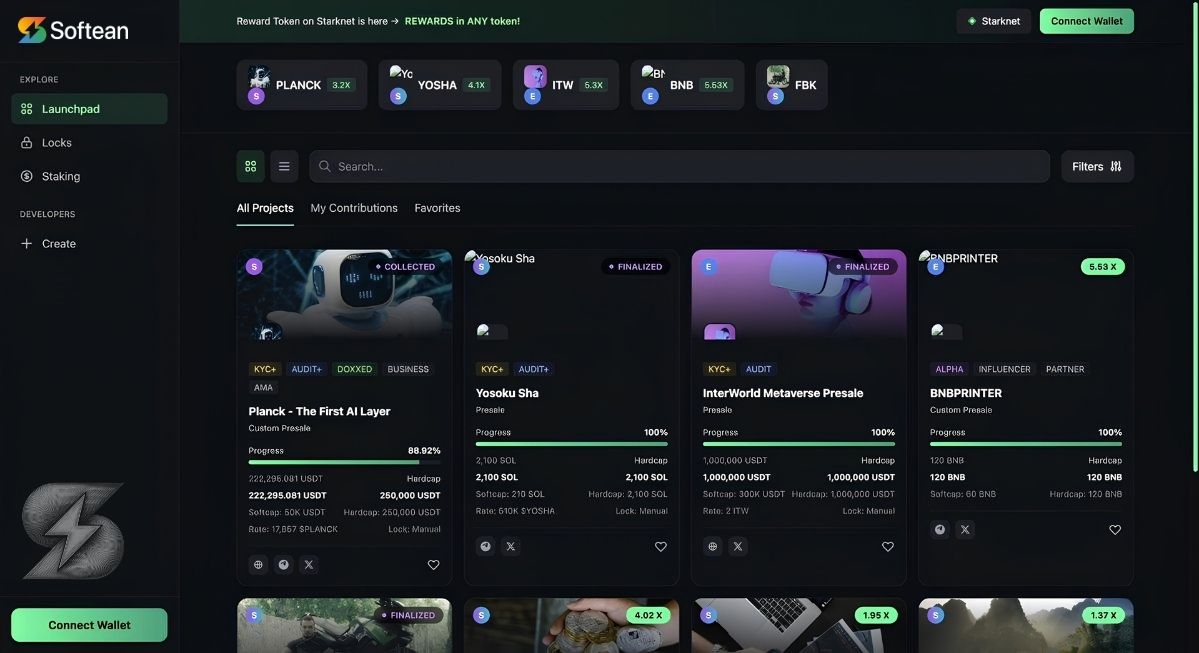
From an investor's perspective, this comes across differently, as the process is relatively simple. They discover a project, review the sale information, complete any required verification, connect a wallet, participate in the offering, and eventually receive or claim their tokens.
But behind that experience, the platform is coordinating multiple systems. Project information needs to be managed, eligibility needs to be determined, transactions need to be recorded, allocation rules need to be enforced, and blockchain activity needs to remain synchronized with the platform. A whole lot of mechanics that need to sync and work right.
The launchpad therefore acts as infrastructure rather than simply a token listing website. Its quality depends on how well the different parts of the fundraising journey work together. A platform with an attractive interface but poorly designed allocation logic is guaranteed to create problems just as easily as a technically strong system with a confusing participation process can lose users.
Types of Crypto Launchpads You Can Build
Different launchpad models have emerged based on how projects want to raise funds and distribute digital assets.
| Type | Purpose | Common Use |
| IDO | Decentralized token offering | DeFi and Web3 projects |
| IEO | Exchange-based token offering | Exchange-backed projects |
| ICO | Direct token offering | Early-stage blockchain projects |
| IGO | Gaming token offering | GameFi projects |
| INO | NFT offering | NFT and digital asset projects |
| Multi-Chain Launchpad | Supports multiple blockchain networks | Multi-ecosystem projects |
The choice of model should be driven by the business the platform intends to serve rather than by the name of the offering alone.
A business can also build a multi-chain launchpad when its strategy involves projects across several ecosystems. This provides broader market coverage but also increases engineering complexity.
These differences need to be considered before multi-chain support is treated as a simple expansion feature.
Essential Features of a Crypto Launchpad Platform
The set of features a crypto launchpad owns ultimately defines the make-or-break point of a crypto launchpad business; we have listed the non-negotiable best features that breathe life into your launchpad.
Project Onboarding and Management
A crypto launchpad needs a structured way to bring projects onto the platform and move them from application to launch. Project teams should be able to submit relevant information, while administrators can review, approve, and manage offerings before they become available to investors. This creates a controlled process for maintaining the quality and consistency of projects hosted on the platform.
Investor Onboarding and Eligibility
Investor participation begins before the token sale itself. Depending on the platform's requirements, users may need to register, complete KYC or other eligibility checks, connect their wallets, and become whitelisted for specific offerings. Bringing these steps into a single workflow makes participation easier to manage while giving the platform greater control over who can access a sale.
Token Sale Management
The token sale engine brings the project's fundraising conditions into operation. Token price, sale duration, contribution limits, accepted assets, and fundraising caps need to be configured consistently so that investors understand the terms and the underlying smart contracts can enforce them.
Allocation and Distribution
When demand exceeds the available token supply, the launchpad needs a clear method for determining allocations. Depending on the business model, this could involve tier-based allocation, guaranteed allocation, lottery mechanisms, or other predefined rules. Once the sale ends, the same infrastructure can support token distribution, vesting, claims, and refunds where applicable.
Wallet and Blockchain Integration
Wallets provide the connection between investors and blockchain transactions, while blockchain integrations allow the launchpad to monitor and process on-chain activity. Supporting multiple networks requires additional consideration because wallet compatibility, transaction handling, smart contract environments, and blockchain infrastructure can differ between ecosystems.
Administration and Analytics
The administrative layer gives the platform operator visibility and control over projects, users, token sales, transactions, and platform activity. Analytics can then help operators understand participation, fundraising performance, transaction activity, and other operational trends as the number of launches grows.
Which Blockchain Should You Choose for Your Crypto Launchpad?
Blockchain selection directly influences transaction costs, smart contract development, wallet compatibility, ecosystem access, and investor experience.
There is no single network suitable for every launchpad business. The choice depends on the target projects, intended fundraising models, supported token standards, and operational budget.
| Blockchain | Technical considerations |
| Ethereum | EVM-compatible smart contracts, established token standards, and broad wallet and tooling support. Transaction fees can vary with network demand. |
| Binance Chain | EVM compatibility and support for Solidity-based contracts and common EVM tooling. |
| Polygon | EVM-compatible development environment and integration with the broader Ethereum tooling ecosystem. |
| Solana | Rust-based on-chain programs, Solana account architecture, and network-specific wallet and transaction integration. |
For an initial launchpad, supporting one blockchain can reduce the complexity of smart contract development, testing, and infrastructure management.
Multi-chain support can be added through a modular architecture after the core fundraising workflow is established.
Cross-chain fundraising introduces additional considerations, including bridge security, cross-chain messaging, transaction finality, and asset reconciliation. It should not be treated as a simple extension of single-chain token sale functionality.
How to Create a Crypto Launchpad?
Creating a crypto launchpad starts with defining how the platform will operate and what kind of projects and participants it intends to serve.
Instead of approaching the process as a sequence of coding tasks, businesses should look at the launchpad as a complete ecosystem with several connected layers.
Here are the major steps to consider.
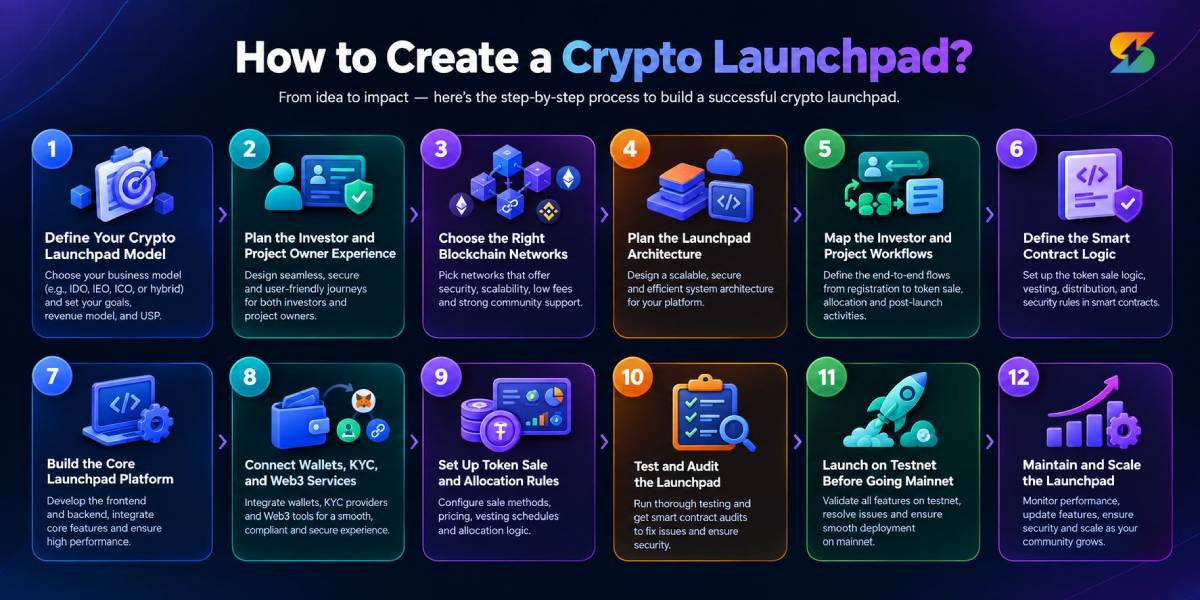
1. Define Your Crypto Launchpad Model
The first stage is to define how the launchpad will operate and the type of projects it will serve. The development team determines the fundraising model, supported blockchain networks, investor eligibility rules, allocation mechanism, token distribution method, and administrative workflow.
These decisions directly influence the platform architecture. A launchpad designed for fixed-price IDOs will have different requirements from a multi-chain platform supporting several sale models. Defining these requirements early prevents major changes to smart contracts and backend systems later in development.
2. Plan the Investor and Project Owner Experience
The interface should be designed keeping in mind how the investors and project owners actually use the platform rather than a template UI/UX. Investors need to understand an offering, check their eligibility, connect their wallet, and participate in the sale, and later claim their allocation without a challenging complexity that tires them.
The project-owner experience requires equal attention as the investors. From submitting a project to configuring its sale and monitoring fundraising activity, each stage should have a clear workflow. The perfect UX is particularly important during live token sales because unclear transaction states or allocation information can create confusion even when the underlying blockchain infrastructure is perfect in operation.
3. Choose the Right Blockchain Networks
The blockchain network determines important characteristics of the launchpad, including transaction costs, confirmation speed, ecosystem reach, and smart contract capabilities. Therefore, the blockchain that backs the infrastructure must be chosen carefully, keeping in mind the types of projects the platform intends to attract and the expected transaction volume.
Multi-chain support requires additional planning, as different networks can have different development environments, token standards, wallet integrations, and transaction behavior.
4. Plan the Launchpad Architecture
The platform architecture should be designed around how a token sale moves from an investor's action to a confirmed result. The development team needs to decide where each part of that process should be executed and how information should move between those layers. A Mandatorily important aspect for a launchpad because a transaction can begin on the platform, but its final outcome is determined by the blockchain.
A strong architecture keeps the parts that require blockchain verification closely tied to on-chain execution while allowing routine platform operations to be handled more efficiently elsewhere. Getting this separation right helps the launchpad remain responsive during high-traffic token sales while ensuring that important transaction outcomes can still be verified independently.
5. Map the Investor and Project Workflows
At this stage, the launchpad's business model is translated into a sequence of decisions and actions that can work in real operating conditions. The project side needs a controlled path from application to an approved token sale, while the investor side needs a process that determines when participation is permitted and what happens after the sale.
The platform should be well prepared when the expected flow doesn’t occur. Unexpected situations should have defined outcomes without being treated as exceptions after development.
6. Define the Smart Contract Logic
The smart contract is where the launchpad's fundraising rules become enforceable on the blockchain. Before writing the contract, the development team needs to determine exactly what the sale is expected to do from opening to completion and what conditions can change its outcome
The intention is to make the fundraising rules predictable even when a high volume of transactions takes place or when something goes haywire; the smart contracts should be well equipped.
7. Build the Core Launchpad Platform
Once the underlying logic has been defined, the application is built to make that logic usable. The Ultimate challenge is to keep what the users see consistent and in sync with what is actually happening on the blockchain.
A careful coordination between the UI and the transactional workflows behind it must be maintained. The platform has to understand what has been requested, what has been confirmed, and what still needs to happen before presenting a final result. Getting this relationship right is particularly important during a busy token launch.
8. Connect Wallets, KYC, and Web3 Services
External integrations should be introduced according to the decisions already made about how the launchpad will operate. A wallet is not simply a connection button, and identity verification is not merely a registration step. Each integration can influence whether an investor is allowed to proceed and how the platform establishes that the transaction belongs to the correct participant.
The development challenge is maintaining a dependable user journey when these external systems do not respond immediately. Verification can take time, wallet transactions can remain pending, and blockchain data can arrive later than expected. The launchpad therefore needs to distinguish between an action that has started and one that has actually been completed, rather than treating every response as a final result.
9. Set Up Token Sale and Allocation Rules
The sale mechanism needs to turn the project's fundraising terms into an outcome that can be calculated consistently. This becomes more complex when investor demand does not match the available token supply. The platform must be well equipped to know how that difference will be resolved before the sale begins.
The development team therefore has to establish how the final entitlement is calculated, recorded, and made available to the investor.
10. Test and Audit the Launchpad
Testing should attempt to break the launchpad rather than simply confirm that its normal workflow works. Token sales involve financial transactions, so a platform that performs correctly under ordinary conditions can still create serious problems when users act simultaneously, transactions arrive unexpectedly, or a sale reaches an unusual state.
Testing should therefore reproduce the conditions the launchpad is likely to face in production, including high participation and abnormal transaction behavior. Security review then examines whether the underlying implementation can be manipulated or accessed in ways that were not intended. Smart contracts require particular attention because an error deployed on-chain can be considerably harder to correct than an application-level defect.
11. Launch on Testnet Before Going Mainnet
The testnet stage is more or less like a simulation; it provides an opportunity to operate the launchpad as closely as possible to its eventual production environment without exposing real funds. Rather than treating testnet deployment as a final demo, the team can use it to observe and double-check the complete fundraising process.
Moving to mainnet should happen only after those results are understood it is good to move to Mainnet. The production deployment establishes the environment in which real assets and users will interact with the platform. Hence, configuration and access decisions need to be reviewed carefully before the first campaign goes live. A controlled initial launch also allows the team to identify operational issues before the platform reaches its intended scale.
12. Maintain and Scale the Launchpad
A launchpad has to remain reliable so as to build trust among clients after its first deployment because its operating environment will continue to change. Blockchain networks introduce updates, integrations change their interfaces, security threats evolve, and project requirements can shift as the platform attracts more users and campaigns.
Maintenance should therefore be considered as part of the platform's lifecycle rather than as bug fixing as it arises. The development team needs to monitor how the system behaves in production, identify emerging risks, and introduce changes without disrupting active fundraising operations.
How Much Does It Cost to Build a Crypto Launchpad?
The cost to create a crypto launchpad depends on the platform's feature set, blockchain integrations, smart contract complexity, security requirements, and development approach.
A basic single-chain launchpad with essential token sale functionality has different development requirements from a multi-chain platform with advanced allocation engines, investor verification, and extensive administrative infrastructure.
| Platform Type | Estimated Development Cost |
| Basic crypto launchpad MVP | 20,000–40,000 |
| Standard IDO launchpad | 40,000–80,000 |
| Advanced multi-chain launchpad | 80,000–150,000+ |
| Enterprise-grade fundraising platform | 150,000–300,000+ |
The crypto launchpad development costs vary with team location, technical scope, integrations, security requirements, and delivery arrangements.
How Long Does It Take to Build a Crypto Launchpad?
Development timelines depend on the number of features, integrations, blockchain networks, and security requirements.
| Development Scope | Indicative Timeline |
| Basic single-chain MVP | 8–12 weeks |
| Standard IDO launchpad | 12–20 weeks |
| Advanced multi-chain platform | 20–32+ weeks |
| Enterprise platform | 6–12+ months |
These are indicative project-planning estimates, not guaranteed delivery periods. Independent audits, regulatory approvals, third-party integrations, and complex custody arrangements can extend the overall launch timeline.
For an initial product, a phased approach can help establish the core fundraising functionality before introducing more complex features.
Key Security Features Every Crypto Launchpad Needs
Security of a crypto launchpad is the foundation of trust that is built with the user base. Security needs to cover the entire launchpad rather than only its smart contracts. The platform connects to multiple layers, and protection must be applied across each layer and should not be mutually exclusive.
- Smart Contract Security
- Platform and API Security
- Wallet and Asset Security
- Anti-Bot and Sybil Protection
- Launch-Day Monitoring
Technologies Used to Build a Crypto Launchpad
The technology stack should be selected around the blockchain environment, expected transaction volume, security requirements, integrations, and scalability objectives. A possible stack for a launchpad may include the following:
Frontend: React.js, Next.js
Backend: Node.js, Python, Java
Smart Contracts: Solidity, Rust
Database: PostgreSQL, MongoDB
Blockchain Integration: Ethers.js, Web3.js
Wallet Integration: WalletConnect, MetaMask, Phantom
Cloud: AWS, Azure, Google Cloud
APIs: REST APIs, Web3 APIs
These technologies are examples rather than a fixed formula. An EVM-based launchpad may require a different contract and integration approach from a platform designed around Solana, while a multi-chain product introduces another set of infrastructure considerations. The final technology stack should be determined after the platform's functional, blockchain, security, and scalability requirements have been established.
Common Challenges in Building a Crypto Launchpad
Launching a fundraising platform involves technical and business challenges that should be addressed before production deployment.
| Challenge | How to Address It |
| Smart contract vulnerabilities | Conduct independent audits, automated testing, and controlled deployment. |
| Low-quality project applications | Establish documented onboarding and technical review procedures. |
| Multi-chain complexity | Use modular blockchain adapters and chain-specific transaction monitoring. |
| Investor trust | Publish transparent sale terms, allocation rules, and token vesting schedules. |
| Regulatory uncertainty | Obtain jurisdiction-specific legal advice and implement eligibility controls. |
| Fundraising failures | Define settlement, refunds, and failed-sale conditions in advance. |
| Platform scalability | Use reliable event indexing, database optimization, and infrastructure monitoring. |
The most important architectural decision is to separate the platform's business workflows from the blockchain-specific components. This makes it easier to introduce new fundraising models, support additional networks, and modify operational processes without rebuilding the entire product.
Why Choose Softean to Create a Crypto Launchpad?
Creating a crypto launchpad requires more than individual blockchain development skills. The platform needs business rules to be translated into smart contracts, blockchain transactions to be connected with conventional application infrastructure, and complex fundraising processes to be presented through a user experience that investors can understand.
Softean approaches launchpad development around this complete product architecture rather than treating the token sale as an isolated component. With over 100+ crypto projects built from scratch and an esteemed client base, we deliver the best crypto launchpad built around your business goals, future-proofed, secure, and scalable in nature, bringing home lucrative profits.
For businesses planning to build a crypto launchpad, the more important question is not simply how many features can be added to the platform. It is whether those features can work together reliably when real projects, real investors, and real assets are involved. Softean, an exceptional crypto launchpad development company, can help businesses design and develop that underlying infrastructure, from initial requirements to smart contract development.
FAQs
Can I Create a Multi-chain Crypto Launchpad?
Yes. A multi-chain launchpad can support fundraising campaigns across multiple blockchain networks through a unified investor interface.
It requires chain-specific wallet integration, smart contracts or programs, transaction monitoring, token standards, and blockchain data indexing.
How Much Does It Cost to Create a Crypto Launchpad?
Crypto launchpad development can range from approximately $20,000 for a basic MVP to $150,000 or more for an advanced multi-chain platform. Enterprise-grade platforms with extensive integrations and security requirements can exceed $300,000.
How Long Does It Take to Develop a Crypto Launchpad?
The development timeline depends on the complexity of the platform. A single-chain launchpad with a focused scope will generally require less development than a multi-chain platform.
A basic single-chain launchpad may take approximately 8–12 weeks, while a standard IDO launchpad may require 12–20 weeks.
Advanced multi-chain and enterprise platforms can take several months or longer, particularly when independent audits, regulatory reviews, and third-party integrations are involved.
Which Blockchain Is Best for a Crypto Launchpad?
Ethereum, BNB Smart Chain, Polygon, and Solana are potential options, depending on the target projects, transaction requirements, wallet ecosystem, and technical architecture.
There is no single blockchain that is universally best for every launchpad. The decision should consider transaction costs, network performance, wallet support, ecosystem activity, liquidity, developer infrastructure, and the type of projects the platform intends to support.
How Can a Crypto Launchpad Prevent Bots and Sybil Attacks?
Launchpads can combine eligibility checks, whitelisting, KYC where applicable, contribution limits, rate limiting, anti-bot mechanisms, and Sybil detection. The appropriate approach depends on the sale model and the level of protection required.
Does a Crypto Launchpad Require KYC and AML?
KYC and AML requirements depend on the launchpad's business model, jurisdiction, supported offerings, and applicable regulations.
Can a Crypto Launchpad Support Multiple Blockchains?
Yes. A launchpad can support multiple blockchain networks. Multi-chain support is best considered during the architecture stage so the platform can accommodate different networks without creating unnecessary technical complexity.
How Does a Crypto Launchpad Generate Revenue?
A launchpad can generate revenue through token sale commissions, project listing fees, launch fees, premium project services, and subscriptions.
Some platforms also use staking or tier-based access mechanisms, although these introduce additional tokenomics and regulatory considerations.
Can I Create a Crypto Launchpad Without Launching My Own Token?
Yes. A business can operate a crypto launchpad using existing blockchain networks and accepted cryptocurrencies without issuing a native platform token.
A launchpad can generate revenue through project launch fees, fundraising commissions, subscriptions, and other platform services, subject to applicable legal requirements