What if owning a fraction of a commercial property could be handled almost as easily as holding a digital asset?
That question sits at the heart of real-world asset tokenization. It is not about integrating blockchain into everything but rather the digital representation of such assets; with proper structural elements, this breathes life into investment, fundraising, asset management, and financial markets.
Right from commercial real estate and government bonds to private credit and intellectual property, tokenization is slowly upping its game on how capital is raised and how investors access traditionally illiquid markets. As institutional adoption continues to grow, businesses are avidly interested in the Real-World Asset Tokenization Use Cases to create new investment products.
In this guide, we explore the most important Real-World Asset Tokenization Examples, how these applications work, and where businesses can find opportunities to build tokenization-based products in 2026.
What Is Real-World Asset Tokenization?
Real-world asset tokenization is the process of representing ownership rights to a physical or financial asset through digital tokens recorded on a blockchain. Depending on the legal structure, a token can represent fractional or whole ownership, an economic interest, a claim on an asset, or rights to its associated cash flows.
People often confuse this concept and connect it with cryptos; unlike cryptocurrencies that exist natively on a blockchain, tokenized assets are connected to something that exists in real life. That underlying asset could be an apartment building, government bond, gold reserve, private equity fund, invoice, or intellectual property right and isn’t limited to a list.
The blockchain provides a transparent digital record of token ownership, while the legal and operational framework determines what that ownership actually represents in the real world.
The process generally involves:
- Identifying and verifying the underlying asset
- Establishing the legal structure for ownership
- Creating the token and its associated smart contract
- Issuing tokens to eligible investors
- Managing ownership, transfers, distributions, and reporting
Traditional Assets vs Tokenized Assets
| Traditional Asset | Tokenized Equivalent |
| Property deed | Digital ownership tokens |
| Government bond certificate | On-chain bond tokens |
| Gold bar | Fractional gold tokens |
| Private equity share | Tokenized fund interest |
| Trade invoice | Digital receivable token |
It is to be noted that asset tokenization isn’t about equalizing as asset to a mere digital asset backed by blockchain but rather connecting legal ownership, financial rights, and blockchain infrastructure into a functioning digital market.
Why Real-World Asset Tokenization Matters in 2026
The ship that focused on whether physical assets could be represented on blockchain has sailed. The conversation has shifted to where tokenization can solve genuine problems in capital markets and asset management.
The strongest opportunities tend to involve assets that are valuable but proportionally difficult to access, transfer, finance, or trade through conventional systems.
Several developments are driving this shift:
- High-value assets can be divided into smaller investment interests, lowering the capital required to participate.
- Financial institutions are exploring tokenized bonds, credit products, funds, and other securities.
- Digital ownership records can reduce reconciliation and administrative friction.
- Tokenized markets can potentially support more flexible transfer and settlement processes.
- Programmable compliance can connect investor eligibility and transaction rules directly to digital infrastructure.
A niche where Real-World Asset Tokenization Use Cases are expanding beyond crypto-native businesses. The technology is increasingly being evaluated as infrastructure for modern capital markets.
12 Real-World Asset Tokenization Use Cases
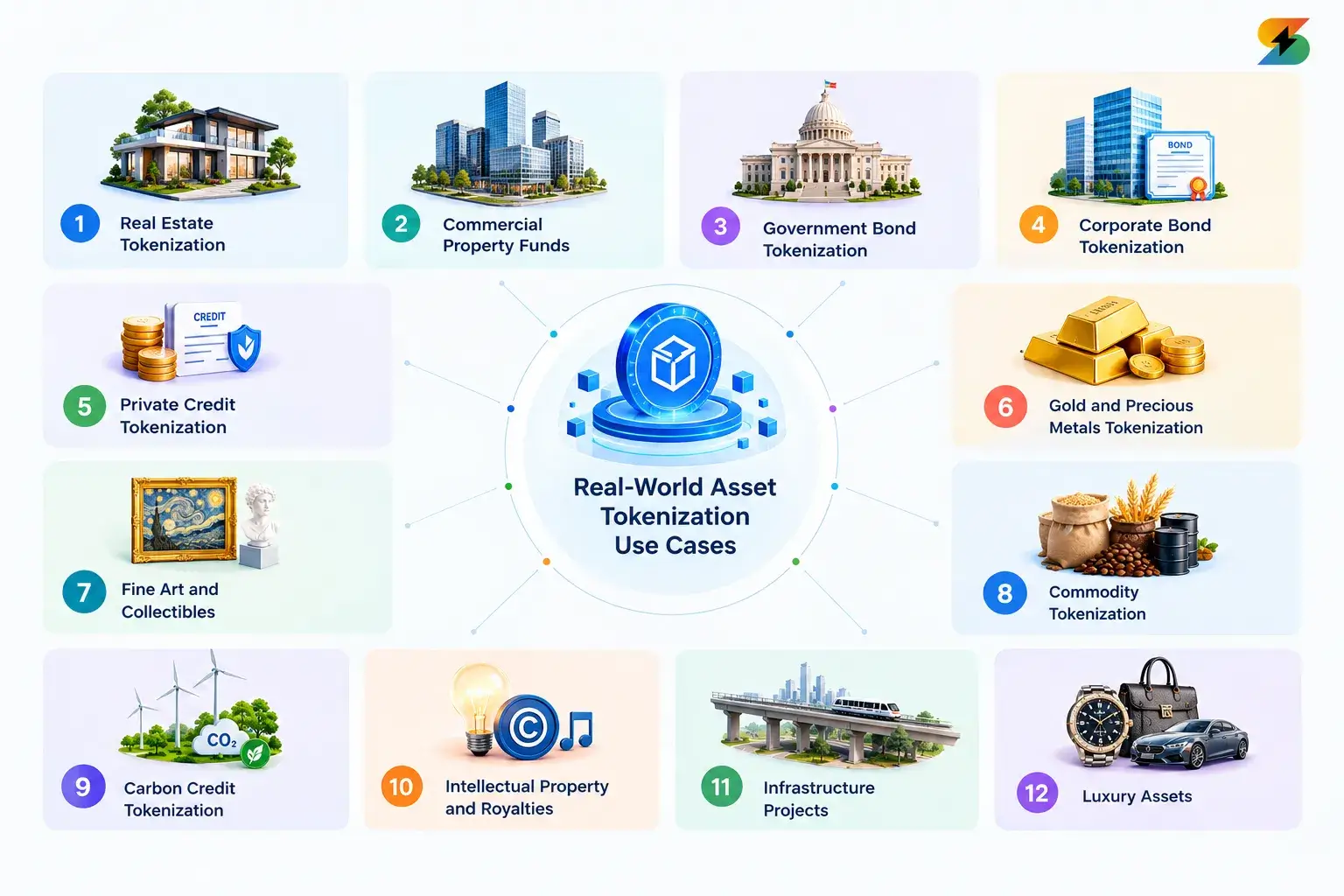
1. Real Estate Tokenization
A very popular segment of tokenization is real estate and is one of the most prominent use cases, as property ownership has traditionally required substantial capital and involves considerable administrative complexity.
Tokenization targets and allows the economic or ownership interest in a property to be divided into smaller digital units. An investor doesn't necessarily need to purchase an entire apartment, office building, or commercial property. Instead, depending on the legal structure, they can participate in a smaller portion of the asset.
For property owners and developers, this becomes a lucrative opportunity and creates another way to raise capital without relying exclusively on conventional financing or selling an entire property.
For investors, the attraction is broader access to assets that would otherwise require significant capital.
This makes real estate tokenization particularly relevant for:
- Property developers
- Real estate investment firms
- REIT operators
- Property crowdfunding businesses
- Digital investment platforms
It is to be noted that tokenization of a property immediately makes the property more valuable. It changes how ownership and investment participation can be structured around it.
2. Commercial Property Funds
Commercial property funds take the real estate model a step further by representing interests in portfolios rather than individual properties. A fund could be holding office buildings, warehouses, retail centers, logistics facilities, or other income-generating properties. Tokenized fund interests can provide investors with digital representations of their participation in that portfolio.
An appeal that stems from combining portfolio diversification with a more digitally native ownership model.
Instead of managing numerous paper-based subscriptions and fractional ownership records, fund operators can create a unified digital environment for investor onboarding, ownership tracking, distributions, and reporting.
Building opportunities for the following:
- Real estate fund managers
- Institutional investment firms
- Property asset managers
- Alternative investment platforms
For this use case, the real opportunity is not simply fractional ownership. It is the modernization of the way real estate investment funds raise capital and manage investor relations.
3. Government Bond Tokenization
A niche that has become eye candy for tokenization because they already represent reliable, standardized financial claims and has strong institutional demand.
Tokenized government securities can represent ownership or economic interests in sovereign debt while using blockchain infrastructure for issuance, settlement, ownership records, and related processes.
Why create a completely new investment product while can improve the infrastructure supporting an established one? That is where the attraction for financial institutions lies.
Potential advantages include:
- Faster settlement processes
- More transparent ownership records
- Digital distribution of interest or other payments
- Reduced operational reconciliation
- Greater integration with digital financial infrastructure
Government securities are particularly important to the RWA market because they demonstrate how blockchain can be applied to traditional financial instruments without requiring the underlying asset to change.
Government securities are important to the RWA market as it
4. Corporate Bond Tokenization
Tokenization is best used in corporate bonds. Corporate bonds allow businesses to raise debt capital from investors, and tokenization modernizes the regular workings like issuance, distribution, management, and transfer.
Why rely on multiple disconnected systems to maintain investor records and process transactions? A tokenized bond can use blockchain-based infrastructure to maintain a public and immutable record.
For issuers, the opportunity lies in creating a more streamlined capital-raising process, and for investors, digital ownership can make portfolio management and transaction processing more efficient.
Corporate bond tokenization can be particularly relevant to:
- Large enterprises
- Financial institutions
- Corporate treasury departments
- Digital securities platforms
- Investment firms
A strong business case is when tokenization reduces the regular operational complexity while maintaining the legal and regulatory requirements associated with the respective securities.
5. Private Credit Tokenization
Private credit is one of the most compelling RWA Tokenization Use Cases; it focuses on the challenge where private lending is hard for small investors to access.
Loans to businesses or other borrowers outside traditional public bond markets are an advantage. These loans bring home attractive returns, but participation often requires substantial capital and usually involves complex fund structures.
Tokenization of these can represent interests in private credit portfolios, allowing eligible investors to participate in these opportunities through smaller digital units.
The model is a win-win and creates value for both sides:
- Businesses gain another potential source of financing.
- Investors gain access to structured credit opportunities.
- Fund managers can manage ownership digitally.
- Platforms can create more efficient investor administration.
6. Gold and Precious Metals Tokenization
Gold becomes a natural candidate for tokenization because physical ownership involves storage, transportation, verification, and transfer considerations, and tokenization becomes a convenient space and eliminates the risks that accompanies
A tokenized gold model connects digital tokens with specific quantities of gold held in custody. Depending on the structure, investors can obtain exposure to smaller portions of the underlying reserve without physically handling the metal.
The same concept is applied to other precious metals:
- Gold
- Silver
- Platinum
- Palladium
For businesses, tokenized precious metals can create digital investment products while retaining the underlying commodity within established custody arrangements.
This is one of the clearest Real-World Asset Tokenization Examples because the relationship between the digital token and physical asset can be direct to understand and verify.
7. Fine Art and Collectibles
Fine art and collectibles can be extremely valuable but remain relatively illiquid. A painting worth millions of dollars cannot easily be divided or sold in the same way as publicly traded securities. Tokenization introduces a way to represent fractional economic interests in these assets.
The model can apply to:
- Fine art
- Rare watches
- Vintage automobiles
- Collectibles
- Historical artifacts
A business opportunity emerges when an asset that usually depends on a small number of wealthy buyers now brings in loads of participants.
Tokenization potentially broadens participation while providing a more structured way to manage ownership, transfers, and distributions.
8. Commodity Tokenization
Physical commodities such as metals, agricultural products, energy resources, and warehouse inventory are usually difficult to finance and transfer because ownership often involves multiple parties and extensive documentation, making it even more complex. Tokenizing commodities eases that challenge and is a best-use case.
Tokenization can create a digital representation of ownership or claims associated with these assets.
Possible applications include:
- Warehouse-backed commodities
- Agricultural inventory
- Industrial metals
- Energy assets
- Commodity financing
For businesses, the opportunity extends beyond investment. Tokenized commodities can support financing, inventory management, and trade workflows.
9. Carbon Credit Tokenization
Carbon credits are increasingly being explored as digital assets because their value depends heavily on verification, ownership, and traceability.
Tokenization can create digital representations of carbon credits, making it easier to track ownership and transfer them within a digital marketplace.
Potential applications include:
- Carbon marketplaces
- Corporate sustainability programs
- ESG investment products
- Environmental asset platforms
The underlying challenge is credibility. A digital token has little value if the environmental asset it represents cannot be properly verified.
For this reason, successful carbon tokenization requires reliable verification of the underlying credits as well as appropriate rules governing issuance and transfer.
10. Intellectual Property and Royalties
Intellectual property creates value through licensing and recurring revenue, which makes royalty streams particularly interesting for tokenization.
Music catalogs, patents, film rights, publishing rights, and software licenses can generate income over extended periods. Instead of selling an entire intellectual property asset, businesses can structure investment around future revenue streams.
For example, a music rights company could acquire a catalog and create a regulated investment product tied to the royalties generated by those recordings.
The same model could apply to patent licensing revenue or film distribution rights.
This creates a different type of tokenization opportunity. The token does not necessarily represent ownership of a physical object. It can represent a legally structured economic interest in future cash flows.
11. Infrastructure Projects
Large infrastructure projects require significant upfront capital, while many generate revenue over long periods.
Tokenization can create another way to structure investment around infrastructure assets and projects such as:
- Solar farms
- Wind farms
- Transportation infrastructure
- Toll roads
- Smart city projects
Instead of depending entirely on traditional institutional financing, project owners can explore structured digital investment models that allow eligible investors to participate in the economic value generated by infrastructure.
For renewable energy projects, this can also create a connection between sustainable development and digital investment markets.
12. Luxury Assets
Luxury assets have high monetary value and often have limited liquidity, a use case that makes it highly viable and a potential application for tokenization.
Businesses can explore digital ownership models around assets such as:
- Yachts
- Collectible automobiles
- Diamonds
- Rare whisky
- Luxury watches
The opportunity is most relevant where the complete asset is inaccessible or too expensive for individual investors but has a strong collector or investment market.
Real-World Asset Tokenization Examples Across Industries
The same tokenization infrastructure can serve very different industries because the underlying business objective changes from one asset class to another.
| Industry | Tokenized Asset | Primary Value |
| Real Estate | Apartments and commercial buildings | Fractional ownership |
| Banking | Government bonds | Digital settlement |
| Finance | Private credit | Access to credit investments |
| Manufacturing | Trade invoices | Working capital |
| Energy | Solar projects | Project financing |
| Commodities | Gold bullion | Digital ownership |
| Media | Music royalties | Revenue distribution |
| Venture Capital | Fund interests | Investor accessibility |
These Real-World Asset Tokenization Examples show why tokenization is becoming broader than a single financial application. The technology can support different models wherever ownership, financing, transferability, or access creates a meaningful business problem.
Emerging RWA Tokenization Applications
The next wave of RWA Tokenization Applications is likely to come from assets that have historically been difficult to finance, divide, or trade. Nevertheless, with growing popularity and evolution, the following applications will be viable to tokenize in the near future.
- Agriculture and Farmland
- Supply Chain and Inventory Financing
- Trade Finance
- Renewable Energy
- Intellectual Property Licensing
Which Assets Are Best Suited for Tokenization?
Not every asset automatically benefits from tokenization. The strongest candidates usually have significant value, clear ownership, limited liquidity, or a need for broader investor access.
| Asset Category | Liquidity Potential | Best For |
| Real Estate | High | Property investment platforms |
| Government Bonds | High | Financial institutions |
| Private Credit | High | Lending platforms |
| Gold | Medium | Commodity investment |
| Fine Art | Medium | Collectibles marketplaces |
| Infrastructure | Medium | Long-term investment funds |
| Invoices | Medium | SME financing platforms |
Businesses should therefore start with the economic problem rather than the technology.
If an asset already has highly efficient ownership and trading infrastructure, tokenization may offer limited additional value. But when ownership is fragmented, entry costs are high, settlement is slow, or secondary liquidity is difficult, tokenization can become considerably more useful.
Challenges of Real-World Asset Tokenization
Though the technology is only one part of the equation, it is to be noted that real-world assets exist within legal, financial, and regulatory systems, so successful tokenization requires all of these layers to mesh together.
| Challenge | Why It Matters |
| Legal ownership | Tokens need to represent enforceable rights |
| Regulatory compliance | Securities, tax, and investor rules vary by jurisdiction |
| Asset custody | Physical assets still require trusted custody and verification |
| Liquidity | Creating tokens does not automatically create a market |
| Valuation | Illiquid assets need reliable and transparent valuation |
A common misconception is that putting an asset on blockchain automatically makes it liquid. That is not the case. Liquidity purely depends on investor demand, market structure, transfer restrictions, pricing, and the existence of a functioning secondary market.
Blockchain is simply a technology, but it shouldn’t be confused with a solution to resolve unclear ownership. If the legal rights behind a token are poorly structured, the technology cannot compensate for that weakness.
That is why serious RWA projects treat legal structuring, compliance, custody, valuation, and market access as fundamental parts of the product rather than secondary considerations.
How Businesses Build a Real-World Asset Tokenization Platform
Building a Real-World Asset Tokenization Platform requires more than developing a token contract. The platform needs to connect the underlying asset with investors, legal ownership, compliance processes, and the marketplace where tokens are issued or transferred.
A typical development process includes:
- Asset verification and due diligence
- Legal structuring of ownership
- Smart contract development
- Token issuance
- Investor onboarding and KYC
- Primary fundraising
- Secondary marketplace integration
- Reporting and compliance
The Future of Real-World Asset Tokenization
Real-World Asset Tokenization in 2026 is increasingly being shaped by financial institutions and enterprises rather than speculation alone. Government securities, private credit, funds, and other traditional financial assets are becoming important areas of experimentation and adoption.
The next stage of growth will likely focus less on creating tokens for the sake of tokenization and more on building reliable markets around them.
That brings greater attention to:
- Regulated digital securities
- Institutional tokenized funds
- Private credit markets
- Cross-border investment
- Digital custody
- Interoperable financial infrastructure
- Programmable compliance and settlement
The long-term opportunity is significant because tokenization can potentially change how existing assets move through financial markets. Instead of creating entirely new asset classes, businesses can modernize the way established assets are issued, owned, financed, and transferred.
Conclusion
Real-world asset tokenization is changing the relationship between physical assets and digital financial markets. Real estate, bonds, private credit, commodities, intellectual property, infrastructure, and other asset classes can all benefit when tokenization addresses a genuine limitation in the existing market.
With an esteemed client base and a team that has worked on more than 100+ intricate blockchain projects, Softean is an excellent choice as an RWA tokenization company. Specializing in customized asset tokenization solutions designed around your asset class, business model, and target market, and providing the technology foundation required to bring real-world assets into the digital economy, we at Softean breathe life into your idea and deliver an exceptional product to the market.