A crypto wallet is no longer limited to storing, sending, and receiving digital assets. Modern wallets can combine token swaps, staking, DeFi access, NFT management, payments, fiat on-ramps, trading, and Web3 applications into a single platform.
For businesses, this creates multiple opportunities to generate recurring and transaction-based revenue.
However, building a crypto wallet app is only one part of launching a profitable wallet business. The bigger question is:
How do you monetize a crypto wallet app without negatively affecting user adoption and retention?
Businesses can generate revenue through transaction fees, swap commissions, staking services, subscriptions, premium features, partner commissions, advertising, and other embedded financial services.
In this guide, we explore 10 crypto wallet monetization models, explain how each model works, and discuss how businesses can choose the right revenue strategy for their wallet.
What Is Crypto Wallet Monetization?
Crypto wallet monetization is the process of generating revenue through a cryptocurrency wallet’s users, transactions, financial services, and ecosystem integrations. Rather than relying on a single source of income, wallet providers can use a mix of monetization strategies that align with their target audience and product capabilities.
For example, a wallet could generate revenue from:
- Transaction fees
- Cryptocurrency swap fees
- Staking commissions
- Premium subscriptions
- Fiat on-ramp and off-ramp commissions
- Partner and referral fees
- DeFi service fees
- NFT marketplace commissions
- Premium security and business features
- Advertising and sponsored placements
The right approach depends on whether the wallet is custodial or non-custodial, mobile or web-based, retail-focused or enterprise-oriented, and whether it supports DeFi, trading, payments, or Web3 applications.
Businesses planning to launch a wallet can also explore crypto wallet development services to build monetization features directly into the wallet architecture.
Why Should Businesses Monetize a Crypto Wallet App?
Developing a crypto wallet requires investment in blockchain infrastructure, security, backend systems, APIs, compliance processes, user experience, and ongoing maintenance.
A well-designed monetization strategy helps businesses recover these costs and transform the wallet from a standalone product into a sustainable, revenue-generating platform.
Key benefits of crypto wallet monetization include:
A strong monetization strategy can help a crypto wallet evolve from a simple asset-storage tool into a scalable digital-finance platform.
Recurring revenue: Premium subscriptions, advanced tools, and paid business features can create more predictable income.
Transaction-based revenue: Wallet providers can earn fees when users complete swaps, transfers, staking actions, fiat purchases, or other supported transactions.
Higher user lifetime value: Offering additional financial services can increase the value generated by each active user over time.
Multiple revenue streams: Combining transaction fees, subscriptions, DeFi services, partner commissions, and enterprise plans reduces reliance on a single income source.
Ecosystem growth: Integrating trading, staking, DeFi, payments, NFTs, and Web3 services can encourage users to spend more time and complete more activities within the wallet.
Business scalability: Digital wallet services can serve a growing user base without requiring a proportional increase in physical infrastructure, supporting more efficient growth.
10 Crypto Wallet Monetization Models
There is no universal revenue model for every crypto wallet. The most successful platforms generally combine several models to create diversified income streams.
Here are 10 ways to monetize a cryptocurrency wallet app.
1. Transaction Fees
Transaction fees are one of the most straightforward crypto wallet monetization models.
A wallet can charge users a service fee when they send, receive, swap, or otherwise transact with supported digital assets.
The business can structure fees as:
- Fixed transaction fees
- Percentage-based fees
- Tiered fees
- Network fee plus service fee
- Variable fees based on transaction type
For example, a wallet could charge a small service fee for transferring cryptocurrency while displaying the underlying blockchain network fee separately.
How it generates revenue
Every eligible transaction can contribute to the wallet's revenue. As transaction volume increases, revenue can scale with platform usage.
However, businesses should clearly distinguish between blockchain network fees and wallet service fees. Network fees are generally paid to the underlying blockchain infrastructure, while the wallet's service fee is the platform's revenue.
Best suited for
- High-volume crypto wallets
- Payment wallets
- Trading-focused wallets
- Multi-chain wallets
- Business wallets
Transaction fees can be particularly effective when the wallet provides additional value through faster execution, transaction management, multi-chain support, or integrated financial services.
2. Cryptocurrency Swap Fees
Built-in token swaps can turn a wallet into a revenue-generating trading environment.
Instead of requiring users to leave the wallet to exchange one cryptocurrency for another, businesses can integrate swap functionality directly into the application.
For example, users may be able to swap:
- ETH for USDC
- BTC for USDT
- SOL for USDC
- Stablecoins for other supported tokens
The wallet can earn revenue by applying a small service fee or receiving a share of the applicable swap economics through its integrated liquidity or exchange infrastructure.
Why Swap Monetization is Attractive?
Users already have assets inside their wallets. Providing an integrated swap experience reduces friction and creates additional opportunities for monetization.
A wallet can also improve revenue potential by supporting:
- Multiple blockchain networks
- Multiple liquidity sources
- Token discovery
- Real-time exchange rates
- Slippage controls
- Swap history
- Gas estimation
Important consideration
Swap fees should be transparent. Excessive fees or unclear pricing can reduce user trust and retention.
3. Staking and Delegation Fees
Staking can create another recurring revenue opportunity for crypto wallet businesses.
If a wallet supports staking, users can potentially delegate or stake eligible digital assets directly from their wallet.
The wallet provider can monetize the service through a commission or service fee associated with staking rewards, depending on the underlying blockchain and service structure.
Example
Suppose a wallet allows users to stake supported assets through integrated validators or staking providers.
The wallet could earn revenue by charging a defined service commission while users receive the remaining applicable staking rewards.
Staking wallet features can include:
- Asset staking
- Validator selection
- Reward tracking
- Staking history
- Unstaking
- Locking and unlocking periods
- Reward notifications
- Portfolio-level staking analytics
Staking is especially useful for wallets targeting long-term crypto holders because it can increase user engagement and encourage users to keep assets within the wallet ecosystem.
4. Premium Subscription Plans
A freemium model can allow businesses to offer basic wallet functionality for free while charging users for advanced capabilities.
This creates a recurring revenue stream through monthly or annual subscriptions.
Free wallet features may include:
- Asset storage
- Basic transfers
- Portfolio tracking
- Basic transaction history
- Standard token support
Premium features could include:
- Advanced portfolio analytics
- Priority customer support
- Enhanced transaction monitoring
- Advanced security controls
- Tax reporting tools
- Premium market insights
- Higher transaction limits
- Business administration features
- Advanced DeFi analytics
Subscription-based monetization works particularly well when the wallet provides meaningful additional value beyond basic cryptocurrency storage and transfers.
Why Subscriptions Matter?
Transaction-based revenue can fluctuate with market activity. Subscription revenue can provide a more predictable income stream and reduce reliance on transaction volume.
5. Fiat On-Ramp and Off-Ramp Commissions
Many mainstream users still need a convenient way to move between traditional currencies and cryptocurrencies.
Integrating fiat on-ramp and off-ramp services allows users to purchase or sell digital assets without leaving the wallet.
For example, a wallet can integrate third-party payment providers that allow users to purchase cryptocurrency using supported:
- Bank transfers
- Debit cards
- Credit cards
- Payment methods
- Local payment rails
The wallet business may earn referral commissions, revenue shares, or service fees based on the commercial agreement with the integrated provider.
Why this Monetization Model Works
A crypto wallet becomes more useful when users can:
Fiat → Crypto → Wallet → Swap/Trade/Stake → Fiat
Keeping more of this journey inside the wallet can increase engagement and create multiple monetization opportunities.
For businesses building a wallet, fiat on-ramp and off-ramp integration should be planned alongside compliance, geographic availability, payment-provider requirements, and user verification workflows.
6. Partner and Referral Commissions
A wallet can generate revenue by partnering with cryptocurrency exchanges, blockchain platforms, payment providers, DeFi protocols, NFT marketplaces, and other Web3 businesses.
The wallet can refer users to partner services and receive commissions or other commercial benefits where applicable.
Potential partners include:
- Cryptocurrency exchanges
- Crypto payment providers
- Blockchain infrastructure providers
- Staking platforms
- DeFi applications
- NFT marketplaces
- Crypto tax platforms
- Web3 applications
- Financial service providers
For example, a wallet could recommend an integrated service when a user wants to buy an unsupported asset, access a specific financial product, or use an external Web3 service.
Key Advantage
Partner monetization allows the wallet to expand its service ecosystem without developing every financial product internally.
However, partnerships should be clearly disclosed to users, and the wallet should prioritize trusted providers.
7. DeFi Service Fees
DeFi integration can transform a basic cryptocurrency wallet into a broader decentralized finance platform. Instead of only storing and sending digital assets, users can access services such as token swaps, staking, lending, borrowing, liquidity pools, and cross-chain transfers directly within the wallet.
Depending on the supported blockchain networks and integrations, users may access services such as:
- Token swaps
- Lending
- Borrowing
- Liquidity provision
- Yield opportunities
- Staking
- Decentralized exchanges
- DeFi portfolio tracking
The wallet can potentially monetize these activities through service fees, integration fees, referral arrangements, or other applicable revenue-sharing models.
Why DeFi can Increase Wallet Revenue
DeFi users often perform multiple financial activities rather than simply holding cryptocurrency.
A wallet that provides access to multiple DeFi services can therefore increase:
- Transaction frequency
- Assets held in the wallet
- User engagement
- Platform utility
- Revenue opportunities
Businesses should carefully evaluate the technical, security, smart contract, and regulatory implications before integrating third-party DeFi protocols.
8. NFT and Web3 Marketplace Commissions
Businesses can generate revenue from marketplace-related activity through transaction commissions, referral fees, partner revenue-sharing agreements, featured listings, or premium NFT-management features. Integrating these capabilities can also make the wallet more useful for users who regularly engage with NFT marketplaces, games, communities, and decentralized applications.
Possible NFT wallet capabilities include:
- NFT portfolio management
- NFT transfers
- NFT discovery
- Marketplace integration
- Collection tracking
- NFT transaction history
- Multi-chain NFT support
For example, if the wallet integrates an NFT marketplace, the business could receive an applicable commission from eligible marketplace transactions.
NFT monetization may be particularly relevant for wallets targeting creators, collectors, gaming communities, and Web3 users.
9. Advanced Security and Business Features
Security is one of the most important considerations in cryptocurrency wallet development.
While basic security should never be treated as a paid add-on, businesses can offer advanced security and management capabilities as part of premium or enterprise packages.
Potential premium capabilities include:
- Multi-signature wallet management
- Role-based access control
- Transaction approval workflows
- Advanced transaction monitoring
- Address whitelisting
- Spending limits
- Risk alerts
- Audit logs
- Enterprise administration
- Advanced backup and recovery tools
This model can be particularly useful for business and institutional wallets, where organizations may require more sophisticated controls than individual users.
Example
A basic wallet could be free for individual users, while an enterprise plan could provide advanced administration, approval workflows, reporting, and security controls for organizations managing digital assets.
This creates a B2B monetization layer alongside the consumer wallet business.
10. Advertising and Sponsored Listings
Advertising can provide an additional revenue stream when a crypto wallet has a large, active, and engaged user base. Wallet providers can offer clearly labeled sponsored placements for relevant services, such as token projects, NFT collections, decentralized applications, exchanges, staking providers, or Web3 marketplaces.
Businesses can display relevant promotions from:
- Crypto exchanges
- Token projects
- Web3 applications
- NFT platforms
- Blockchain services
- Financial service providers
Potential placements include:
- Sponsored token listings
- Partner offers
- Promotional banners
- Featured Web3 applications
- Sponsored educational content
However, advertising should be implemented carefully.
Crypto users are particularly sensitive to scams, misleading token promotions, and questionable financial products. Sponsored content should therefore be clearly labeled, and businesses should establish strict partner and listing criteria.
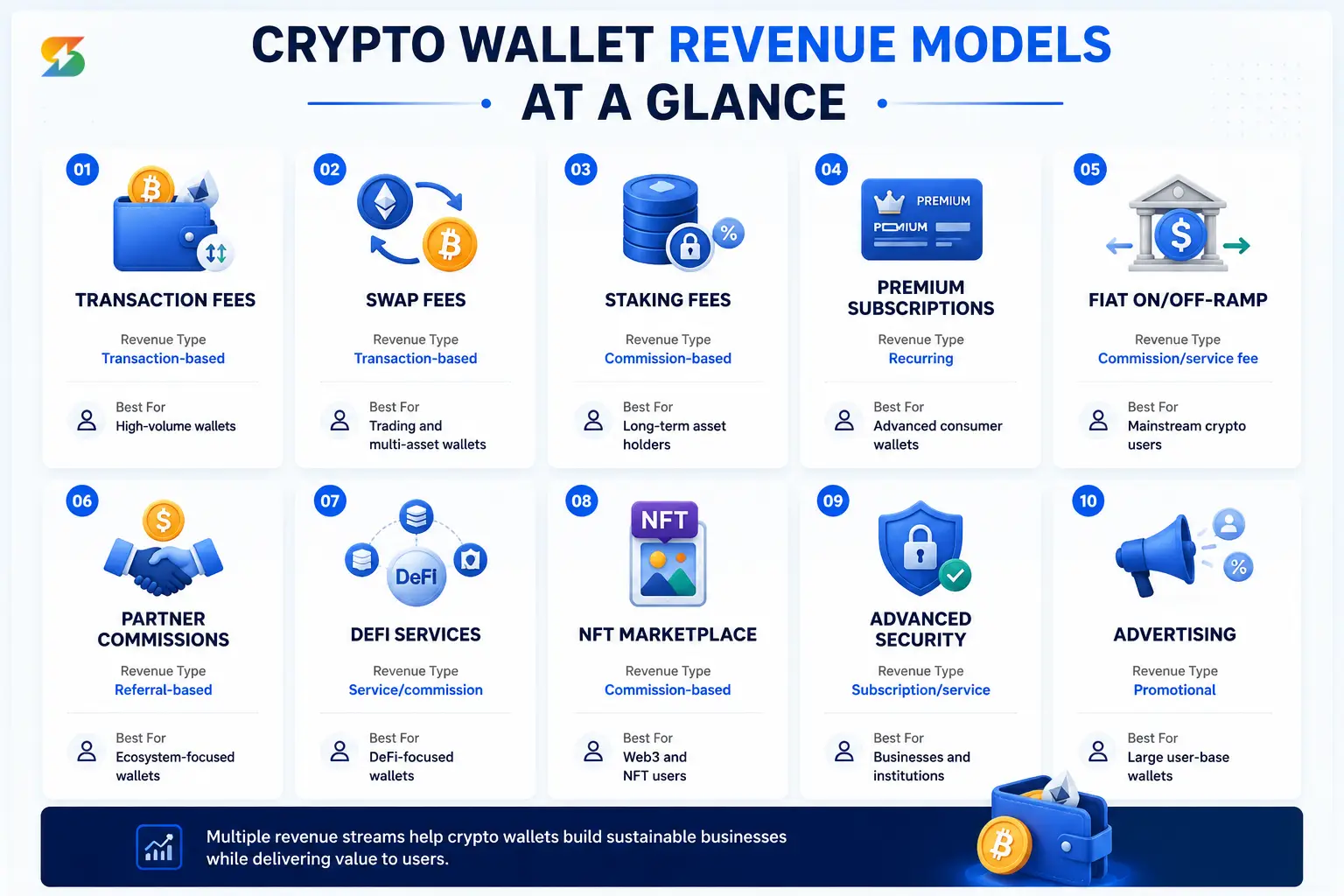
Crypto Wallet Revenue Models at a Glance
| Revenue Model | Revenue Type | Best For |
| Transaction Fees | Transaction-based | High-volume wallets |
| Swap Fees | Transaction-based | Trading and multi-asset wallets |
| Staking Fees | Commission-based | Long-term asset holders |
| Premium Subscriptions | Recurring | Advanced consumer wallets |
| Fiat On/Off-Ramp | Commission/service fee | Mainstream crypto users |
| Partner Commissions | Referral-based | Ecosystem-focused wallets |
| DeFi Services | Service/commission | DeFi-focused wallets |
| NFT Marketplace | Commission-based | Web3 and NFT users |
| Advanced Security | Subscription/service | Businesses and institutions |
| Advertising | Promotional | Large user-base wallets |
How to Choose the Right Crypto Wallet Monetization Model
Choosing a revenue model should not be based only on how much money a particular feature can generate.
The monetization strategy should align with the wallet's target audience, functionality, transaction volume, geographic market, compliance requirements, and long-term business model.
Consider these factors before selecting your revenue streams.
1. Identify Your Target Users
Start by defining whether the wallet is designed for individual consumers, businesses, or both. Each group has different needs, usage patterns, and willingness to pay.
A consumer wallet may benefit from swap fees, staking, subscriptions, and partner commissions.
An enterprise wallet may be better suited to premium administration, security, compliance, reporting, and transaction management features.
Aligning the monetization approach with the user’s specific needs helps the wallet generate revenue without creating unnecessary friction or reducing trust.
2. Analyze Wallet Usage Patterns
Understanding how users interact with the wallet helps identify the most suitable revenue opportunities. Monitor which features users engage with most often, such as asset swaps, transfers, staking, portfolio tracking, or long-term storage.
By aligning monetization with actual wallet behavior, providers can introduce paid services that feel useful rather than intrusive.
3. Avoid Excessive Fees
A monetization strategy should not make the wallet feel unnecessarily expensive. High transaction, swap, or service fees can frustrate users and encourage them to move their assets to competing platforms.
Keep fees competitive, clearly explain what each charge covers, and show the total cost before users confirm a transaction. Transparent pricing helps establish trust, reduces surprises, and makes users more likely to continue using paid wallet services.
4. Combine Multiple Revenue Streams
Relying on a single revenue source can make the business vulnerable to market fluctuations.
A diversified wallet business could combine:
Transaction fees + swap fees + staking + premium subscriptions + partner commissions
Using multiple monetization channels creates independent revenue opportunities while reducing dependence on any single feature or market trend.
5. Build Monetization Into the Wallet Architecture
Revenue-generating capabilities should be considered during the initial crypto wallet development process rather than added as an afterthought.
The wallet architecture should be designed to support APIs, blockchain integrations, payment providers, liquidity sources, staking providers, analytics, subscriptions, and other monetization components.
How to Increase Crypto Wallet Revenue Without Losing Users
Crypto wallet monetization should enhance, not compromise, the user experience. The most sustainable revenue model gives users clear value, keeps core functions accessible, and avoids unexpected costs.
Keep Pricing Transparent
For businesses offering crypto wallet services, clear fee visibility can reduce transaction drop-offs, prevent billing disputes, and improve user confidence across token swaps, fiat on-ramp purchases, staking, and other monetized wallet services.
Monetize Value-added Services
A crypto wallet app can offer premium portfolio analytics, token swap integration, staking tools, fiat on-ramp access, tax reporting, real-time security alerts, or enterprise-grade approval workflows. This approach helps businesses generate revenue while giving users a clear reason to upgrade.
Offer a Free Entry Point
For a crypto wallet app, the freemium approach can reduce adoption barriers while creating a clear path to premium upgrades. Users can later choose advanced features such as token swap tools, staking, analytics, enhanced security, or enterprise wallet controls based on their needs.
Personalize Premium Features
Different classes of traders look for different levels of service quality. Active traders may value advanced portfolio analytics, real-time market insights, price alerts, and detailed transaction data, while businesses often need stronger administration, approval workflows, and reporting tools.
Optimize Transaction Flows
For businesses investing in crypto wallet development services, optimized transaction flows can improve conversion rates, reduce drop-offs, and create a smoother user experience across token swaps, fiat on-ramp payments, staking, and other monetized wallet features.
Prioritize Security
A crypto wallet monetization strategy can only succeed when users feel confident that their assets and personal data are protected. If the wallet lacks trust, even strong revenue features such as swaps, staking, subscriptions, or fiat on-ramp integrations will struggle to retain users.
How Softean Helps Businesses Build Monetizable Crypto Wallets
Softean provides crypto wallet development solutions for businesses looking to launch secure, scalable, and feature-rich cryptocurrency wallets.
The development approach can be tailored around the wallet's business model and target users.
Our Crypto Wallet solutions can include:
- Custom crypto wallet development
- Multi-chain wallet development
- Mobile crypto wallet development
- Web crypto wallet development
- Non-custodial wallet development
- DeFi wallet development
- Enterprise crypto wallets
- White-label wallet solutions
- Token swap integration
- Staking integration
- dApp connectivity
- NFT wallet functionality
- Fiat payment integrations
- Advanced wallet security
Rather than treating monetization as a separate layer, businesses can incorporate revenue-generating functionality into the product architecture from the beginning.
This can help create a wallet that is not only technically capable but also designed around a sustainable business model.
For businesses planning to launch a new wallet, monetization should be considered from the beginning of the crypto wallet development process. This allows the technical architecture, integrations, security controls, user experience, and business model to work together.
If you are planning to build a secure and scalable crypto wallet app with built-in revenue streams, Softean can help you design and develop a wallet around your business requirements.