Crypto wallets have become an essential part of the digital asset ecosystem. From individual investors managing cryptocurrency to businesses operating cryptocurrency exchanges and Web3 applications, wallets have become the infrastructure required to access and manage blockchain-based assets.
As cryptocurrency adoption expands, businesses are increasingly looking beyond existing wallet applications. They want customized solutions that support multiple blockchain networks, provide greater control over private keys, integrate with trading platforms, and offer a consistent user experience across devices.
But the biggest question is: how do you create a crypto wallet that can securely manage digital assets, process blockchain transactions, and support real-world business requirements?
Building a cryptocurrency wallet involves much more than developing a mobile application with send and receive functionality. It requires a combination of blockchain integration, cryptographic key management, transaction processing, secure infrastructure, backend engineering, and application development.
In this guide, we will help you understand how to create a crypto wallet from the ground up, covering wallet architecture, development approaches, deployment considerations, and everything you need to know.
Whether you are planning a Bitcoin wallet, a multi-currency wallet, or a custom cryptocurrency wallet for your business, understanding these steps will help you make informed development decisions.
What Is a Crypto Wallet?
A cryptocurrency wallet is a software application or hardware device that allows users to manage blockchain-based assets through cryptographic keys. It enables users to check balances, receive cryptocurrencies, and make transactions.
Unlike traditional banking applications, cryptocurrency wallets do not directly store digital currencies. The assets remain recorded on their respective blockchains. A wallet manages the keys and transaction information required to access and control those assets.
Every wallet operates using two important cryptographic components:
- Public key and wallet address
- Private key
Public key and wallet address: A public key is a key generated from a private key and used for address generation on a particular blockchain. A wallet address is the identifier that can be used by other people to send you cryptocurrency.
Private key: A private key is a cryptographic key that allows you to perform transactions and proves possession of the assets. If someone gets access to a private key, they will have total control over the funds.
Hierarchical deterministic (HD) key generation is used by most wallets today. They allow having multiple addresses and accounts generated from a single recovery seed.
Understanding this architecture is the first step when planning cryptocurrency wallet development.
How Does a Crypto Wallet Work?
A cryptocurrency wallet enables interaction with blockchains through cryptographic key management and transaction communication.
When a user initializes the wallet, the application securely provisions cryptographic materials that will be used to manage the wallet and initiate transactions. It derives all relevant public keys and addresses according to the specific blockchain.
The basic flow of the transaction consists of:
- Wallet creation: The application initializes a private key or recovery seed using a cryptographic random number generator.
- Address generation: Public keys and the respective address are created based on the private key.
- Balance retrieval: The wallet communicates with a blockchain node, RPC provider, or indexing service to retrieve account balances and transaction history.
- Transaction creation: When a user sends cryptocurrency, the application prepares a transaction containing the destination, amount, network information, and required transaction parameters.
- Signing a transaction: The transaction is signed using the appropriate private key or an authorized signing mechanism.
- Broadcasting the transaction: The signed transaction is submitted to the blockchain network through an RPC endpoint or node.
- Network validation: The validators or miners process the transaction as per the consensus algorithm used by the blockchain.
- Transaction state change: The wallet monitors the transaction hash and changes its state based on the validation performed by the network.
The approach varies across different blockchain networks. For example, Ethereum transactions use account nonces, gas values, and transaction signatures. Bitcoin transactions follow the UTXO approach, where the wallet chooses the available transaction outputs and creates inputs and outputs.
A wallet supporting multiple blockchain networks must account for these differences rather than treating every transaction as an identical operation.
Types of Cryptocurrency Wallets You Can Build
Before starting development, businesses should identify the wallet model that matches their operational requirements, security responsibilities, and target users.
1. Custodial Crypto Wallet
A custodial wallet is a type of cryptocurrency wallet where third parties, such as a company running that wallet software or an exchange, have control of user private keys.
Users can access their cryptocurrency balances and initiate transactions through the application, while the wallet provider manages the underlying signing infrastructure.
This model is commonly used by crypto exchanges, brokerage platforms, and centralized financial applications.
Technical considerations:
- Centralized key management infrastructure
- Encrypted key storage and access controls
- Role-based administrative permissions
- Transaction authorization workflows
- Withdrawal limits and risk monitoring
- Audit trails and operational controls
- Recovery and incident response procedures
Custodial wallets provide businesses with greater control over user account management and transaction policies. However, they also introduce significant security, operational, and regulatory responsibilities.
2. Non-Custodial Crypto Wallet
A non-custodial wallet gives users control over their private keys. The application facilitates blockchain interactions without requiring the business to hold users' signing keys.
Private keys can be generated and stored locally on the user's device, protected by secure hardware-backed storage where available.
Technical considerations:
- Local private key generation
- Recovery phrase management
- HD wallet derivation
- Secure transaction signing
- Device-level encryption
- Backup and recovery mechanisms
- Blockchain RPC integrations
This approach is best suited to businesses developing self-custodial wallet apps where users have direct control over their digital assets.
3. Hot Wallet
The hot wallet stays connected to the internet and allows interaction with the blockchain in real time. It is widely used for daily cryptocurrency transactions, withdrawals from exchanges, and interactions with decentralized applications.
Hot wallet infrastructure should include transaction monitoring, access restrictions, rate limits, signing controls, and appropriate limits on exposed funds.
4. Cold Wallet
A cold wallet keeps private keys offline or isolated from internet-connected systems. It is primarily used for long-term cryptocurrency storage and protection of assets from theft.
The purpose of the cold wallet is to protect cryptocurrencies stored in the wallet against theft.
Cold storage solutions may use hardware security devices, air-gapped signing environments, or offline key generation and backup procedures.
For businesses operating custodial platforms, cold storage is always combined with hot-wallet facilities.
5. Multi-Currency and Multi-Chain Wallet
A multi-currency wallet allows users to manage multiple digital currencies using one app.
Depending on its architecture, it can support Bitcoin, Ethereum, BNB Smart Chain, Solana, Polygon, Arbitrum, TRON, and many other blockchains.
Multi-chain wallet development requires network-specific transaction handling, address derivation, token standards, RPC integrations, and balance indexing.
For example:
- Bitcoin uses the UTXO transaction model.
- Ethereum supports account-based transactions and ERC-20 tokens.
- BNB Smart Chain supports EVM-compatible transactions and BEP-20 tokens.
- Solana uses a different account and transaction model, with SPL tokens.
How to Create a Crypto Wallet?
Building a cryptocurrency wallet requires a structured development process. Each stage contributes to the wallet's functionality, security, and ability to handle blockchain operations.
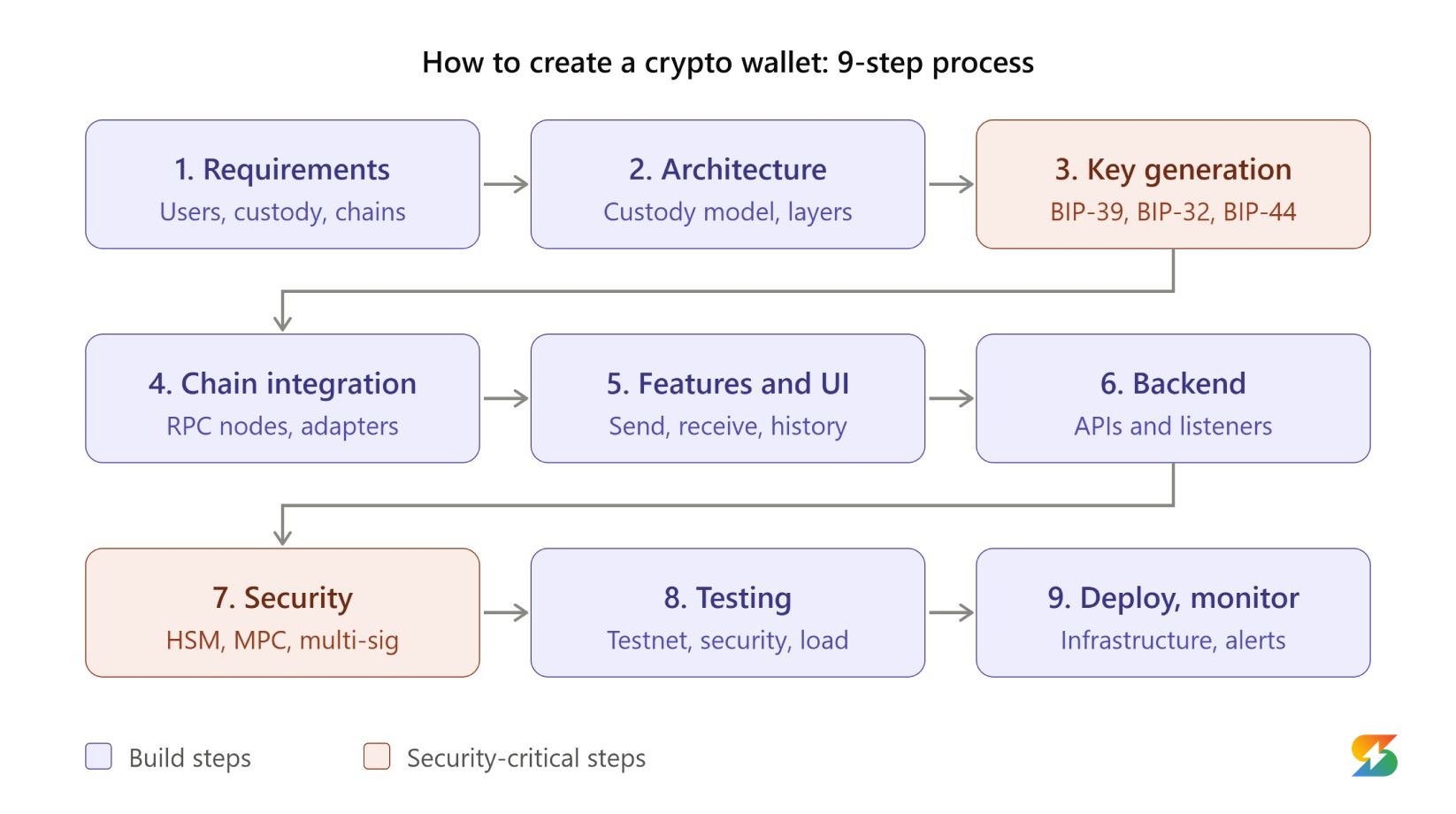
Step 1: Define the Wallet Requirements and Business Model
Start by identifying the purpose of the wallet and the users it will serve.
A wallet built for individual cryptocurrency investors will have different requirements from those designed for a cryptocurrency exchange or fintech platform.
Define the following:
- Target users and business requirements
- Custodial or non-custodial architecture
- Supported blockchain networks
- Required cryptocurrencies and token standards
- Mobile, web, or desktop application requirements
- Fiat payment and exchange integrations
- Transaction limits and approval workflows
- Security and regulatory requirements
- Expected user volume and transaction throughput
For example, a non-custodial multi-chain wallet could consider local key storage, seed phrase recovery, and DApp compatibility.
A custodial exchange wallet could include hot and cold wallets, withdrawal approvals, transaction monitoring, and other functionalities. Identifying the requirements early on will help decide the right architecture and technology stack.
Step 2: Choose the Wallet Architecture
The wallet architecture determines how cryptographic keys, blockchain connections, and application services interact. A typical wallet system contains the following layers:
Frontend Application: Provides the interface for wallet creation, authentication, balance monitoring, transaction history, and asset management.
Wallet Management Layer: Handles wallet creation, account management, address generation, key derivation, and wallet-specific operations.
Cryptographic Signing Layer: Performs transaction signing using private keys, secure hardware, HSMs, or an MPC-based signing infrastructure, depending on the wallet model.
Blockchain Integration Layer: Connects the application with blockchain nodes, RPC providers, transaction broadcasting services, and network indexing systems.
Backend Services: Manage user accounts, application settings, notifications, transaction metadata, business rules, and administrative functions.
Database and Infrastructure Layer: Stores application data, configuration, transaction metadata, and operational records without unnecessarily exposing private keys.
A simplified wallet architecture looks like this:
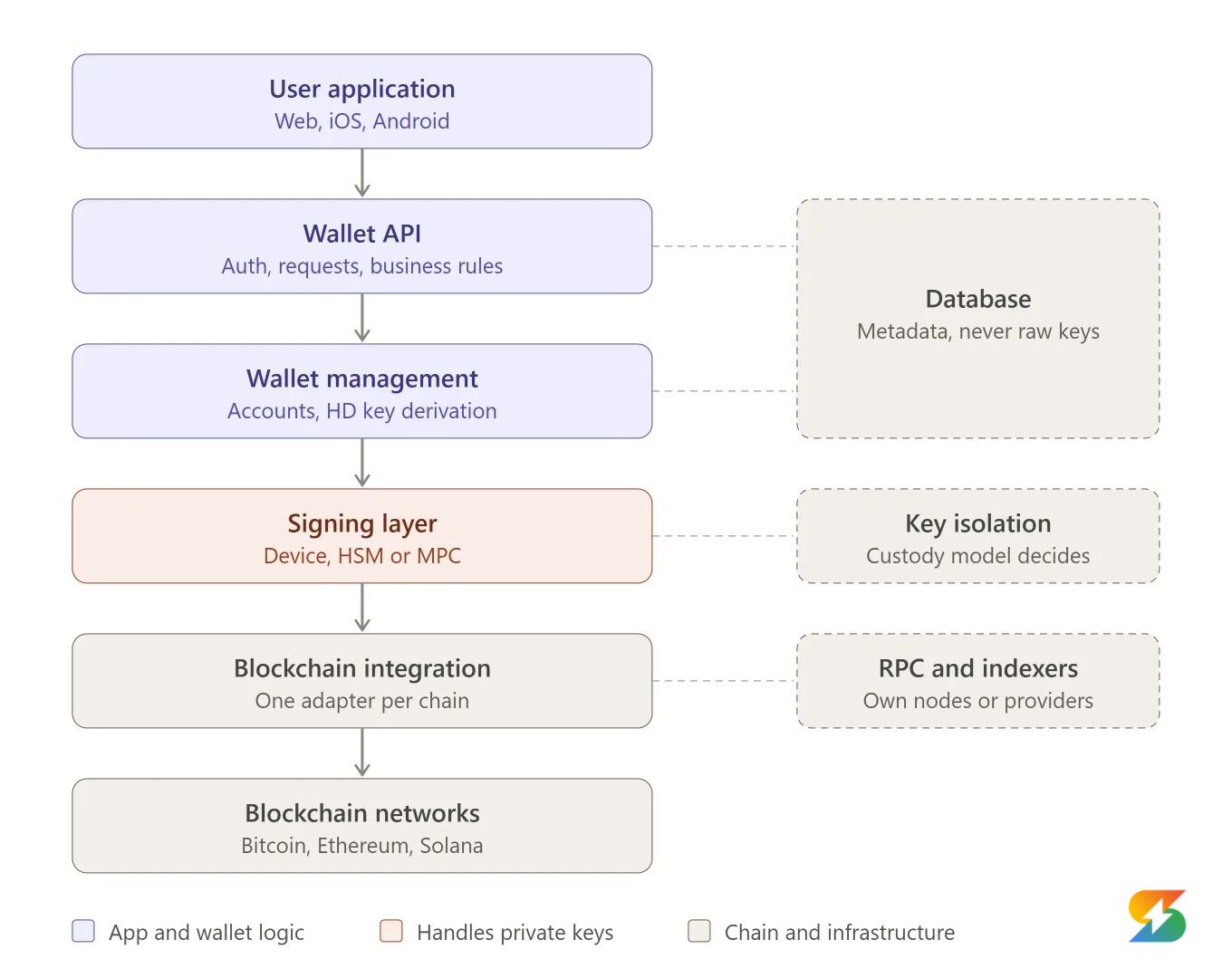
When a user sends cryptocurrency, the app submits the request to the Wallet API. Wallet management resolves the account and key path, the signing layer produces the signature, and the blockchain integration layer broadcasts the transaction through an RPC node. The database stores metadata only, never raw private keys.
In a non-custodial wallet, signing operations should generally remain on the user’s device or within an appropriately isolated signing environment. The backend should not receive private keys simply because it needs to process a transaction request.
In a custodial wallet, key management and signing services require stricter infrastructure isolation, access controls, and monitoring.
The architecture should reflect the custody model instead of using one generic design for every wallet.
Step 3: Implement Cryptographic Key Generation and Management
Private key management is one of the most important aspects of developing a crypto wallet. It involves the process of generating cryptographic keys, address derivation, and preventing unauthorized access to signing material.
For HD wallets, the process commonly follows established standards:
BIP-39: Defines the generation of mnemonic phrases from cryptographic entropy and their conversion into a seed.
BIP-32: Defines hierarchical deterministic key derivation.
BIP-44: Defines a multi-account derivation structure for cryptocurrency wallets.
A simplified HD wallet generation process is:
- Generate secure random entropy.
- Convert the entropy into a mnemonic recovery phrase using the applicable standard.
- Derive a wallet seed from the mnemonic and optional passphrase.
- Generate a master private key and chain code.
- Derive child keys according to the required derivation path.
- Generate blockchain-specific public keys and addresses.
For example, common derivation paths include:
- Bitcoin: m/44'/0'/0'/0/0 for a traditional BIP-44 account.
- Ethereum: m/44'/60'/0'/0/0.
- Other networks: Use their applicable standards and wallet conventions.
These paths are examples, not universal rules. Different address formats, account models, and wallet implementations may require different derivation paths.
Private Key Protection Mechanisms
Depending on the wallet architecture, developers can implement:
- AES-256 encryption for appropriate stored sensitive data.
- Secure Enclave or Android hardware-backed Keystore integration.
- Hardware Security Modules (HSMs) for protected key operations.
- Multi-Party Computation (MPC) for distributed signing.
- Strict access control and key rotation procedures.
- Secure backup and recovery mechanisms.
For non-custodial applications, the private keys must not be sent to application servers or exposed through logs, analytics systems, or error reports. For custodial service providers, encryption of key storage only is not enough. The protection of access, signatures, management, and key recovery needs to be taken care of as well.
Step 4: Integrate Blockchain Networks
Blockchain integration allows the wallet to fetch balances, create transactions, broadcast signed transactions, and track network confirmations. Wallets can be connected to blockchain networks either using developer nodes or third-party RPC services.
Bitcoin Integration
The Bitcoin wallet has to deal with UTXO selection, transaction inputs, outputs, fees, change addresses, and transaction broadcasting.
An indexing service monitors transactions on an address and fetches the transactions' information. It is also important for developers to consider confirmation monitoring and reorganization.
Ethereum Integration
Ethereum wallets interact with the network through JSON-RPC methods. Common operations include:
- Retrieving account balances.
- Reading transaction counts and nonces.
- Estimating gas requirements.
- Preparing native ETH transfers.
- Interacting with smart contracts.
- Sending ERC-20 token transactions.
- Tracking transaction receipts and confirmations.
Libraries such as ethers.js and web3.js can simplify EVM-compatible blockchain integration.
Solana Integration
Transaction processing for Solana wallets is done differently using public keys, the latest blockhash, transaction instructions, and network fees. The wallet should also be able to handle Solana accounts and SPL tokens when needed.
Multi-chain Integration
When building a multi-chain wallet, each network should have its own integration module. A common interface can standardize operations such as:
- Get balance
- Generate address
- Estimate transaction fee
- Build transaction
- Sign transaction
- Broadcast transaction
- Retrieve transaction status
Step 5: Develop Wallet Features and User Interfaces
The user interface should make complex blockchain operations understandable without hiding transaction details. A ready-to-use cryptocurrency wallet typically contains the following features.
Wallet Creation and Authentication
Users should be able to create a wallet, import an existing wallet, and access their accounts; all must be possible for users.
The authentication criteria will vary depending on the custody model being used. Device authentication can be used in a non-custodial wallet to control access to the account.
Wallet Balance and Portfolio Tracking
Display cryptocurrency balances, token holdings, and portfolio values. Balance information should be retrieved from trusted blockchain data sources, while fiat valuations can be obtained through integrated market data providers.
Send and Receive Cryptocurrency
Allow users to send assets using destination addresses, QR codes, or supported address resolution methods. The transaction interface should display:
- Destination address
- Transfer amount
- Selected blockchain network
- Estimated network fee
- Total transaction cost
- Relevant token approval or contract interaction details
Transaction History
Provide transaction records with timestamps, transaction hashes, network details, amounts, and confirmation status. For transparency, users should be able to open the corresponding blockchain explorer.
Token Management
Provide facilities for adding, showing, and handling tokens that are supported. For EVM networks, this usually involves supporting ERC-20 or other similar standards where needed. Different networks have their own way of dealing with token accounts and assets.
QR Code Functionality
Generate wallet address QR codes and allow users to scan recipient addresses.
Notifications
Notify users about incoming transfers, completed transactions, failed transactions, and important wallet activities.
Additional Business Features
Depending on the target market, businesses may also require:
- Token swaps
- In-app cryptocurrency purchases
- Fiat on-ramp and off-ramp integrations
- Staking interfaces
- DeFi and dApp connectivity
- NFT management
- WalletConnect integration
- Multi-account management
- Portfolio analytics
Step 6: Build the Backend and Wallet Infrastructure
The backend links the application interface to the wallet services, blockchain network, and other infrastructure.
In the case of a custodial wallet, the backend takes an especially significant role since it manages the user accounts, transaction approvals, signing process, and transfer of funds. The standard backend implementation includes:
- User and account services: Manage registration, authentication, account settings, and user permissions.
- Wallet services: Manage wallet records, address associations, supported networks, and account configurations.
- Transaction services: Validate requests, apply business rules, prepare transactions, and coordinate signing and broadcasting.
- Blockchain listeners: Monitor incoming transactions, confirmations, smart contract events, and relevant network activity.
- Notification services: Deliver transaction alerts and security notifications.
- Administrative services: Provide controlled access to operational monitoring, transaction reviews, and configuration management.
- Database infrastructure: Store user information, wallet metadata, transaction records, and application settings.
Sensitive key material should remain within dedicated security boundaries rather than being stored as ordinary application records.
For higher-volume platforms, asynchronous processing, message queues, caching, and dedicated indexing services can help manage blockchain events and transaction workloads.
Step 7: Implement Crypto Wallet Security
Security should be an inherent part of the wallet architecture from the very beginning. It should not be considered a last-minute development process.
The cryptocurrency wallet stores sensitive cryptographic keys and performs transactions. Any vulnerability in its key management or transaction authorization process results in the loss of assets. Important security measures include:
Private Key Encryption and Isolation
Protect private keys using appropriate cryptographic and hardware-backed mechanisms. Restrict access to key material and avoid exposing it to unrelated application components.
Multi-factor Authentication
For custodial applications, use additional authentication factors for sensitive operations such as account recovery, device changes, and withdrawals. MFA does not replace secure private key management.
Multi-signature Authorization
Multi-signature wallets require multiple independent signatures to authorize supported transactions.
For example, a business treasury wallet may require two out of three authorized signers before a transaction can be executed.
MPC-based Signing
Multi-Party Computation distributes signing responsibilities across multiple parties or devices. It can reduce the risks associated with a single complete private key, depending on the protocol and implementation.
Transaction Monitoring
Monitor unusual transaction patterns, unexpected withdrawal activity, repeated failed authentication attempts, and other suspicious behavior.
API and Infrastructure Security
Implement API authentication, authorization, rate limiting, input validation, secure secrets management, and network segmentation.
Smart Contract Security
If the wallet includes swaps, staking, token approvals, or other smart contract interactions, assess the security of both the contracts and transaction construction logic.
Independent Security Testing
Conduct code reviews, penetration testing, cryptographic implementation reviews, and smart contract audits where applicable.
Security standards and testing frameworks such as OWASP guidance, NIST cryptographic recommendations, and established blockchain security practices can help structure the assessment.
No single mechanism guarantees wallet security. The complete system must be evaluated, including application code, cryptographic operations, infrastructure, third-party integrations, and operational procedures.
Step 8: Test the Wallet Before Launch
Testing should cover both application functionality and blockchain-specific behavior.
A wallet that functions well during ordinary operations might not work during network latency issues, RPC disconnections, double requests, or unusual transaction statuses. A comprehensive testing process should include:
Functional Testing
- Wallet creation and import
- Address generation and validation
- Balance retrieval
- Cryptocurrency transfers
- Token transfers
- Transaction history
- Fee estimation
- Authentication and recovery
Blockchain Integration Testing
Test against the relevant blockchain testnets and controlled environments. Validate transaction construction, signing, broadcasting, confirmation tracking, nonce handling, and UTXO selection.
Security Testing
Assess authentication, authorization, key storage, API security, dependency vulnerabilities, sensitive-data exposure, and transaction approval mechanisms.
Performance Testing
Measure API response times, transaction processing capacity, indexing performance, and application behavior under concurrent usage.
Failure and Recovery Testing
Simulate RPC failures, delayed confirmations, dropped connections, duplicate requests, chain reorganizations, and interrupted signing operations.
For custodial systems, test the process for withdrawing from the test network, hot wallet limitations, cold storage, and recovery procedures. Passing a testnet transaction does not mean the wallet is ready to go into production mode. Mainnet deployment should follow controlled testing and independent security assessment.
Step 9: Deploy and Monitor the Crypto Wallet
Once development and testing are complete, the wallet can be prepared for production deployment. The deployment process should include:
- Production infrastructure configuration
- Secure environment and secrets management
- RPC endpoint configuration
- Database and backup setup
- Monitoring and alerting
- API gateway and access controls
- Application release management
- Incident response procedures
- Security and infrastructure reviews
Mobile applications should be prepared for the relevant app stores, while web wallets require secure hosting, application delivery, and domain configuration.
After launch, monitor transaction success rates, RPC availability, confirmation delays, API errors, unusual account activity, and infrastructure health.
Wallet maintenance is an ongoing responsibility. Blockchain networks evolve, dependencies receive updates, and security vulnerabilities may emerge after launch.
Technology Stack for Crypto Wallet Development
The technology stack depends on the wallet's supported platforms, blockchain networks, custody model, and expected workload. The following technologies are commonly considered when building cryptocurrency wallet applications.
Web frontend: React.js, Next.js, Angular
Mobile development: React Native, Flutter, Swift, Kotlin
Backend: Node.js, Go, Python, Java
Database: PostgreSQL, MongoDB, Redis
Blockchain integration: Bitcoin Core, Ethereum JSON-RPC, Solana RPC
EVM libraries: ethers.js, web3.js
Cryptography: OpenSSL, libsodium, and vetted cryptographic libraries
Key protection: HSM, Secure Enclave, Android Keystore
Signing architecture: Local signing, MPC, multi-signature
Cloud infrastructure: AWS, Microsoft Azure, Google Cloud
DevOps: Docker, Kubernetes, CI/CD
These are technology options rather than a mandatory combination.
For example, a multi-chain mobile wallet may use React Native for the application, Node.js for backend services, and dedicated blockchain adapters for Bitcoin, Ethereum, and Solana.
A custodial wallet may require a different architecture, with isolated signing services, HSM-backed key protection, transaction-approval workflows, and additional operational controls.
Technology selection should follow the security and performance requirements of the wallet, not simply the popularity of a particular framework.
How Much Does It Cost to Create a Crypto Wallet?
The development cost for a crypto wallet would usually lie within the range of $10,000 to $150,000+, depending on the wallet design, compatibility with blockchain protocols, security needs, app platforms, and the extent of the features implemented.
Here is an estimated cost breakdown based on project scope:
| Wallet Development Type | Estimated Cost |
| Basic single-currency wallet | 10,000 - 20,000 |
| Multi-currency crypto wallet | 20,000 - 45,000 |
| Multi-chain crypto wallet | 35,000 - 75,000 |
| Advanced non-custodial wallet | 40,000 - 90,000 |
| Enterprise custodial wallet | 75,000 - 150,000+ |
These estimates are indicative development budgets, not fixed quotations. Actual costs depend on the technical scope and implementation requirements.
Key factors influencing crypto wallet development costs:
- Wallet architecture: Custodial, non-custodial, and MPC-based wallets require different engineering approaches.
- Blockchain integrations: Supporting Bitcoin, Ethereum, Solana, and other networks increases integration and testing requirements.
- Application platforms: Developing Android, iOS, and web applications affects the overall budget.
- Security implementation: HSM integration, multi-signature authorization, MPC signing, and independent security audits add costs.
- Advanced functionality: Token swaps, staking, NFT management, fiat integrations, and DeFi connectivity increase development complexity.
- Infrastructure requirements: Blockchain nodes, RPC providers, cloud hosting, monitoring, and maintenance contribute to ongoing expenses.
For an accurate estimate, consult with our team before finalizing the development budget.
How Long Does It Take to Build a Crypto Wallet?
Developing a cryptocurrency wallet typically takes 2 to 8 months, depending on its functionality, blockchain integrations, application platforms, and security requirements. The estimated development timelines for different wallet solutions are:
| Wallet development type | Estimated timeline |
| Basic single-currency wallet | 4–6 weeks |
| Multi-currency crypto wallet | 8–12 weeks |
| Multi-chain crypto wallet | 12–16 weeks |
| Advanced non-custodial wallet | 14–20 weeks |
| Enterprise custodial wallet | 5–8 months |
Different development phases and their estimated durations:
| Development phase | Estimated duration |
| Requirement analysis and architecture | 1–2 weeks |
| UI/UX design | 1–3 weeks |
| Frontend and backend development | 3–6 weeks |
| Blockchain integration | 2–4 weeks |
| Security implementation | 2–4 weeks |
| Testing and quality assurance | 2–3 weeks |
| Production deployment | 1 week |
Some development activities can run in parallel, so the phase durations should not simply be added together.
The final timeline depends on the number of supported networks, complexity of key management, third-party integrations, security assessments, and application deployment requirements.
Softean can help businesses plan custom crypto wallet development based on their technical requirements, target launch date, and budget. Our team can evaluate the required architecture, blockchain integrations, and security components to establish a realistic project roadmap.
Common Challenges in Crypto Wallet Development
Creating a crypto wallet involves technical challenges that need to be addressed during architecture and implementation.
1. Private Key Security
It is difficult to keep private keys secure across a variety of devices, situations, and user scenarios. A wallet must prevent accidental exposure while maintaining practical access and recovery mechanisms.
2. Multi-chain Compatibility
Blockchain systems operate using varying formats for transactions, addresses, fees, and signature mechanisms. A robust architecture for integration is important.
3. Transaction Reliability
RPC interrupts, network congestion, wrong fee estimates, and transaction replacement may interfere with the transaction process. The wallet should manage such cases without causing inconsistencies in application state.
4. Scalability
As the number of users and transactions increases, blockchain indexing, balance retrieval, transaction monitoring, and API services can become performance bottlenecks.
5. Wallet Recovery
Recovery methods should balance usability and security considerations. There is a need to consider recovery methods such as recovery phrases in the context of migrating devices and accounts.
6. Regulatory and Operational Requirements
Depending on the business model and jurisdiction, custodial services, exchange integration, and fiat payment processing functions can give rise to various regulatory requirements such as licensing, AML/KYC, data protection, and others.
These requirements should be assessed with qualified legal and compliance professionals before launch.
Crypto Wallet Development: Build From Scratch or Use a White-Label Solution?
Businesses planning to launch a cryptocurrency wallet generally have two development approaches.
Custom Crypto Wallet Development
Custom development involves designing and building the wallet architecture according to specific business requirements. It provides control over the application interface, supported networks, key management model, backend infrastructure, and feature roadmap.
This approach is suitable for businesses that need specialized wallet functionality, unique security requirements, deeper platform integrations, or long-term product ownership.
White-Label Crypto Wallet Development
The white-label wallet will give you a base wallet that can be branded and customized according to your choice. It helps save some initial engineering effort, depending on the design and customization of the product.
However, businesses should evaluate the underlying key management model, supported networks, source code access, integration flexibility, security practices, and vendor dependency before choosing a solution.
| Consideration | Custom wallet | White-label wallet |
| Architecture | Designed around business requirements | Based on existing architecture |
| Customization | Extensive | Depends on the solution |
| Development effort | Generally higher | Can be lower |
| Technical ownership | Defined by the project agreement | Depends on vendor terms |
| Blockchain support | Selected and implemented as required | Limited to available integrations and extensions |
| Feature roadmap | Greater control | Depends on customization capabilities |
Why Choose Softean for Crypto Wallet Development?
Building a cryptocurrency wallet requires expertise in blockchain engineering, application development, cryptography, backend infrastructure, and security architecture. As a crypto wallet development company, Softean combines these capabilities to build custom wallet solutions that align with your business model, technical requirements, and target users.
For businesses planning to create a cryptocurrency wallet, our development approach can cover:
- Custom wallet architecture: Design wallet infrastructure based on custodial, non-custodial, or multi-chain requirements.
- Blockchain integration: Connect supported networks such as Bitcoin, Ethereum, BNB Smart Chain, Solana, and other blockchain ecosystems.
- Private key management: Implement appropriate cryptographic key generation, storage, and signing mechanisms.
- Multi-currency support: Develop wallet functionality for native cryptocurrencies and supported token standards.
- Mobile and web applications: Build wallet interfaces for web, Android, and iOS platforms.
- Backend infrastructure: Develop APIs, transaction services, blockchain listeners, and administrative components.
- Security engineering: Integrate access controls, secure storage, transaction authorization, and security testing.
- Third-party integrations: Connect payment providers, market data services, blockchain explorers, and other required platforms.
We define the development scope based on your business model, supported blockchain networks, target audience, and operational requirements rather than relying on a fixed wallet architecture.
Whether you are planning to build a self-custody wallet, a multi-currency application, or a wallet integrated with an existing cryptocurrency exchange, Softean can help you plan and build a solution that meets your product requirements.
Frequently Asked Questions About Creating a Crypto Wallet
1. How do I create a crypto wallet from scratch?
To create a crypto wallet from scratch, define the wallet architecture, implement cryptographic key generation, develop address derivation, integrate blockchain networks, build transaction processing functionality, and implement security controls. The application must then undergo functional, blockchain integration, and security testing before production deployment.
2. How much does it cost to develop a crypto wallet?
Crypto wallet development costs will fall under $10,000 - $150,000+, depending on the wallet type, supported blockchain networks, application platforms, security architecture, and required features. A basic wallet and an enterprise multi-chain wallet have substantially different engineering requirements. A technical scope assessment is necessary to prepare an accurate estimate.
3. How long does it take to build a cryptocurrency wallet?
The timeline depends on the number of supported networks, features, platforms, and security requirements. Wallets with advanced key management, multiple blockchain integrations, and third-party services require additional development and testing.
4. Can I create a crypto wallet that supports multiple cryptocurrencies?
Yes. A multi-currency wallet can support different cryptocurrencies and token standards through blockchain-specific integrations. The application must implement the appropriate address generation, transaction signing, balance retrieval, and fee estimation mechanisms for each network.
5. What is the difference between custodial and non-custodial wallets?
A custodial wallet allows a service provider to manage private keys on behalf of users. A non-custodial wallet gives users control over their private keys and transaction signing. The main differences involve key ownership, security responsibilities, recovery mechanisms, and operational requirements.
6. How are private keys generated in a crypto wallet?
Private keys are generated using cryptographically secure random number generation. HD wallets can use standards such as BIP-39 and BIP-32 to create recovery seeds and derive multiple key pairs. The resulting keys must be protected according to the wallet's custody and security architecture.
7. Which blockchains can be integrated into a crypto wallet?
Depending on the project requirements, a wallet can integrate Bitcoin, Ethereum, BNB Smart Chain, Solana, Polygon, TRON, Arbitrum, and other blockchain networks. Each network requires its own transaction handling and integration logic.
8. Is it possible to develop a crypto wallet for Android and iOS?
Yes. Cryptocurrency wallets can be developed for Android and iOS using native technologies such as Kotlin and Swift or cross-platform frameworks such as React Native and Flutter. The implementation must account for each platform's secure storage and application security capabilities.
9. How can I secure a cryptocurrency wallet?
A cryptocurrency wallet can be protected through secure key generation, encrypted storage, hardware-backed key protection, controlled transaction signing, multi-factor authentication where applicable, access restrictions, transaction monitoring, and independent security testing. The appropriate controls depend on the wallet's custody model.
10. Can a crypto wallet integrate with a cryptocurrency exchange?
Yes. A wallet can integrate with cryptocurrency exchanges through APIs or dedicated backend services, depending on the required functionality. Integrations can support trading, balance synchronization, deposits, withdrawals, and other exchange-related workflows.
11. Can I create a crypto wallet without holding users' private keys?
Yes. A non-custodial wallet can allow users to generate and control their private keys locally. The application can communicate with blockchain networks without transmitting users' private keys to the service provider.
12. What technologies are used to develop a crypto wallet?
Common technologies include React, Next.js, React Native, Flutter, Node.js, Go, PostgreSQL, Redis, Bitcoin Core, Ethereum JSON-RPC, Solana RPC, ethers.js, and secure cryptographic libraries. The final stack depends on the wallet architecture and supported networks.
13. Does a crypto wallet need a blockchain node?
Not necessarily. A wallet can connect to blockchain networks through self-hosted nodes or third-party RPC providers. Self-hosted infrastructure offers greater operational control, while external providers can reduce node management requirements. The choice depends on reliability, privacy, cost, and infrastructure requirements.
14. Can a crypto wallet support staking, token swaps, and NFTs?
Yes. These capabilities can be integrated through blockchain protocols, smart contracts, decentralized exchange interfaces, and NFT standards. Each feature introduces additional integration, transaction handling, and security requirements.
15. Can Softean develop a custom cryptocurrency wallet?
Yes. Softean provides blockchain and software development capabilities for businesses planning custom cryptocurrency wallet solutions. The development scope can include wallet architecture, blockchain integrations, cryptographic key management, mobile and web applications, backend services, and security implementation.