Real estate asset tokenization has been considered one of the most valuable and stable investment sectors in the world. Startups, property developers, real estate firms, and institutional investors are actively exploring how to tokenize real estate assets to create more accessible, transparent, and efficient investment ecosystems. By converting property ownership into blockchain-based digital tokens, businesses can enable fractional ownership and boost liquidity in assets that were previously difficult to trade.
As the adoption of digital assets continues to accelerate, tokenized real estate is emerging as one of the strongest opportunities in the blockchain space. But many businesses entering this market still have that one major question. How to tokenize real estate in 2026? In this guide, we will break down everything you need to know. Whether you are a startup founder, real estate developer, or property promoter, this guide will provide a clear roadmap for understanding and entering the real estate tokenization space.
What Is Real Estate Tokenization?
Real estate tokenization is the process of converting property ownership rights into blockchain-based digital tokens. These tokens represent shares in a real estate asset and allow investors to buy, sell, or trade fractional ownership digitally. Instead of requiring one investor to purchase an entire property, this tokenization concept enables multiple investors to participate in real estate investment with their small investment amounts.
This model combines the best of both worlds of blockchain technology with real estate to create a more accessible and liquidity-ready real estate ecosystem. Through smart contracts and decentralized infrastructure, tokenized real estate platforms can automate ownership transfers and investor management to bring a more efficient system than traditional systems.
Demand for fractional investing continues to grow. BCG projects that the market will grow from $120 billion in 2023 to $3.2 trillion in 2030 at a CAGR of 49%. This is where real estate tokenization has become a major opportunity for startups, property developers, and investment firms looking to modernize the global property market.
How to Tokenize Real Estate: Step-by-Step Process
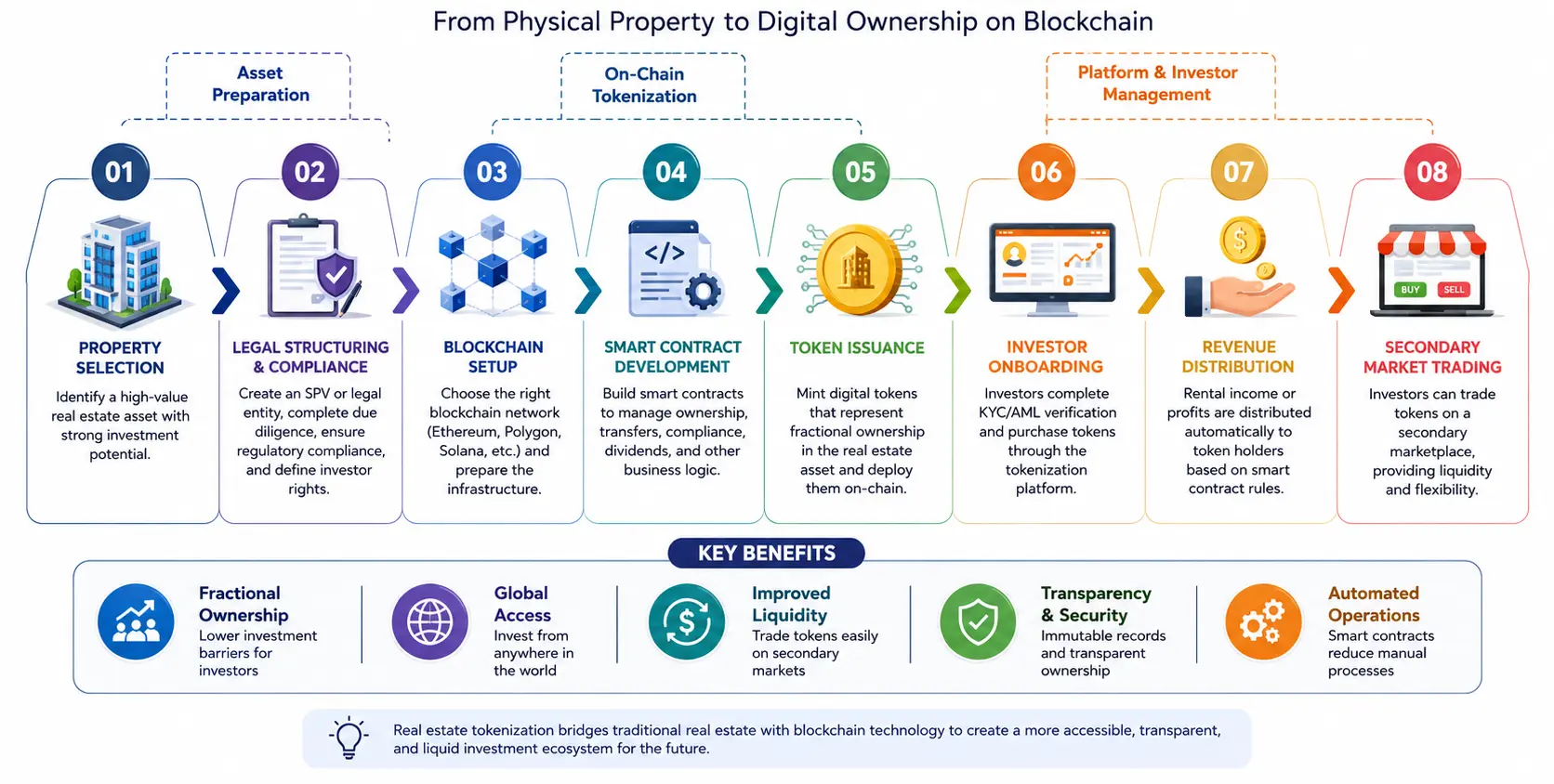
Below is the complete step-by-step process of how real estate tokenization works, from property selection to launching a fully operational tokenized real estate platform.
Step 1 – Select the Real Estate Asset
This is the very first step in real estate tokenization, identifying the property that will need to be converted into digital tokens. Businesses usually choose assets with strong investment potential and high market demand.
Before moving to the tokenization stage, businesses need to perform a property valuation and market analysis to ensure that the asset is legally valid and financially suitable for fractional investment opportunities.
Step 2 – Create the Legal Structure
Once the property is finalized, a legal framework must be established to connect the physical asset with blockchain-based ownership. Many businesses create a Special Purpose Vehicle (SPV) to legally represent the property and define investor ownership rights. This stage also involves regulatory compliance, documentation, and more.
The legal structure plays a major role in protecting the investors, managing ownership distribution, and ensuring the tokenized asset follows regional securities and real estate regulations. Proper legal planning also helps build long-term investor trust.
Step 3 – Choose the Blockchain Network
After finalizing the legal work, the next step is selecting the blockchain infrastructure that will power the tokenized real estate platform. There are all the commonly used networks: Ethereum, Polygon, and Solana. The blockchain choice widely depends on scalability, transaction speed, and support.
Businesses also need to evaluate transaction costs, smart contract capabilities, and network security before selecting the blockchain, because choosing the right infrastructure is more important for long-term scalability.
You May Also Like: Choosing the Best Blockchain for Tokenization
Step 4 – Develop Smart Contracts
Smart contracts are developed to automate tasks such as ownership management, token transfers, and compliance functions. These help to reduce manual operations while improving transparency and operational efficiency across the platform.
In addition, smart contracts can automate rental income distribution, investor verification, transfer restrictions, and transaction execution. This creates a more secure and streamlined tokenized investment ecosystem.
Step 5 – Mint and Issue Real Estate Tokens
After the infrastructure is ready, digital tokens representing fractional ownership of the property are created and issued on the blockchain. Each token represents a share of the real estate asset and can provide ownership rights or a rental income share, depending on the platform model.
During this stage, you need to define token supply, allocation models, investor participation rules, and asset valuation structures to ensure the token economy is properly managed and aligned with the investment strategy.
Step 6 – Launch the Investor Platform
Then, we need to launch the property tokenization platform with features such as user onboarding, KYC/AML verification, wallet integration, and all other necessary features. This platform allows investors to purchase, manage, and monitor their tokens.
A well-designed investor platform should improve user experience by offering advanced portfolio dashboards, transaction tracking, investment analytics, and secure payment systems that simplify participation for both retail and institutional investors.
Step 7 – Enable Secondary Marketplace Trading
Many real estate tokenization platforms integrate secondary trading functionality to improve liquidity. This allows investors to buy or sell their property tokens through a digital marketplace instead of waiting for the physical asset to be sold traditionally.
Secondary marketplaces help create a more flexible investment environment where token holders can manage their assets more efficiently while increasing accessibility and market participation across the platform.
How Does Real Estate Tokenization Work?
By enabling fractional ownership and borderless investment access, real estate tokenization is creating a more efficient & scalable future for property investment platforms.
Types of Real Estate Assets That Can Be Tokenized
Real estate tokenization is not limited to a single property category. Almost every type of real-world property asset can be converted into blockchain-based digital tokens depending on the business model.
Residential Properties
Residential real estate is one of the most commonly tokenized asset categories. Apartments, villas, and rental homes can be divided into fractional tokens, which allows multiple investors to participate in property ownership with low capital.
Commercial Real Estate
Commercial buildings such as office spaces and shopping complexes are highly suitable for tokenization due to their large asset value and long-term revenue generation potential. Also, investors can earn returns through rental income.
Rental Income Properties
Income-generating rental properties are ideal for tokenized investment models because revenue distribution can be automated through smart contracts. Token holders will receive the periodic rental income based on their percentage.
Luxury Real Estate
High-value luxury properties often have limited investor accessibility in traditional markets. But tokenization enables fractional ownership of premium villas, resorts, and penthouses, which makes luxury investments more accessible to all investors.
Land and Development Projects
Land assets and upcoming real estate developments can also be tokenized to get fundraising and investor participation. Property developers often use tokenization models to attract capital for construction and infrastructure expansion projects.
Hospitality and Mixed-Use Properties
Hotels, resorts, and mixed-use properties are increasingly entering this ecosystem. These properties can generate diversified revenue streams, offering investors broader exposure in the real estate market.
Benefits of Tokenizing Real Estate
Tokenizing real estate is transforming the traditional property investment industry by introducing several benefits compared to conventional real estate markets, making investments more accessible, efficient, and flexible.
Fractional Ownership Accessibility
One of the biggest advantages of real estate tokenization is fractional ownership. Investors no longer need a huge amount of capital to participate in premium property investments. Instead, users can purchase smaller ownership tokens, making real estate investment more accessible.
Improved Liquidity
Traditional real estate assets are often considered illiquid because selling properties can take a few months. But with tokenized real estate platforms, secondary marketplace trading is introduced, allowing investors to buy and sell property tokens more efficiently.
Global Investment Opportunities
Blockchain-powered tags remove geographical limitations by enabling cross-border property investment. Investors from different countries can access tokenized real estate assets digitally without any traditional barriers.
Faster and More Efficient Transactions
Real estate tokenization simplifies ownership transfers and investment processes through a smart contract. This reduces paperwork and accelerates transaction settlements compared to traditional systems.
Enhanced Transparency and Security
Blockchain technology provides immutable transaction records and transparent ownership tracking. Every transaction is recorded on-chain, which improves trust and reduces fraud risks to create a more secure investment environment.
Lower Operational Costs
By automating many administrative and transactional processes, tokenization can help reduce operational expenses associated with brokers, paperwork, legal coordination, and more.
Automated Revenue Distribution
Smart contracts can distribute rental income, dividends, or profit-sharing rewards to token holders based on their ownership percentage. This improves efficiency and reduces manual revenue management processes.
Increased Fundraising Opportunities
Property developers and businesses can use tokenization to raise capital more efficiently by attracting both retail and institutional investors globally. This creates a new opportunity for funding for large-scale infrastructure projects.
Challenges in Tokenizing Real Estate Assets
Despite its growing popularity and investment potential, real estate tokenization still has a few limitations that need to be addressed before starting to build your project to build a secure and compliant, ready tokenization platform.
Regulatory Uncertainty
This is one of the biggest challenges in real estate tokenization. Different countries have different rules regarding digital assets. Businesses should ensure their platform complies with local regulations to avoid unnecessary legal complications.
Complex Legal Structuring
A strong legal framework is required to tokenize real estate that connects physical property ownership with blockchain-based digital tokens. Creating SPVs, defining investor rights, and handling ownership documentation can become legally complex.
Limited Market Adoption
Many traditional real estate investors and institutions are still unfamiliar with tokenized property investment models. Investor education and market trust remain major barriers to wider adoption.
Smart Contract Security Risks
Poorly developed smart contracts and security vulnerabilities can create financial & operational risks for both ends. So building a secure and bug-free RWA platform is non-negotiable.
Investor Trust and Transparency
Since real estate tokenization is still an emerging industry, building investor confidence is essential. Businesses must maintain transparent operations and reliable compliance systems to establish long-term credibility in the market.
Region-Wise Legal and Compliance Considerations in Real Estate Tokenization
This business model operates within highly regulated financial and property markets, which makes legal structuring and compliance one of the most critical parts of building a tokenized real estate platform.
United States Regulations
In the USA, tokenized real estate offerings are generally regulated by the U.S. Securities and Exchange Commission (SEC).
Most platforms operate under exemptions such as Regulation D (Rule 506(c)) for accredited investors and Regulation S for offshore investors.
European Regulatory Framework
In Europe, real estate tokenization is influenced by frameworks such as MiFID II, AIFMD, and the Markets in Crypto-Assets Regulation (MiCA).
Depending on how the tokenized asset is structured, the token may fall under existing securities laws rather than standard crypto regulations.
UAE Regulations
The United Arab Emirates has become one of the fastest-growing regions for blockchain and real-world asset tokenization.
Regulatory authorities such as the Abu Dhabi Global Market (ADGM) and Dubai International Financial Centre (DIFC) have introduced digital asset frameworks that recognize tokenized securities.
Why Startups and Real Estate Businesses Are Entering the Tokenization Market
The real estate industry is rapidly moving toward blockchain-powered investment models as businesses look for more efficient ways to capitalize on this trend. It is becoming a strategic business opportunity for all real estate businesses.
Growing Demand for Fractional Investment
Modern investors are actively looking for flexible and accessible investment opportunities. That's the perk that tokenization allows investors to participate in premium real estate projects with lower capital. This significantly expands the potential investor base compared to a traditional one.
Easy to Tap Global Investors
Tokenized real estate platforms enable businesses to attract investors from different regions through digital investment ecosystems. This borderless investment model helps startups and property firms expand fundraising opportunities beyond just the local market.
Faster Fundraising and Capital Generation
Property developers are increasingly using tokenization to accelerate funding. Instead of relying solely on banks or institutional financing, businesses can raise capital directly from retail and institutional investors through tokenized asset offerings.
Competitive Advantage in the Digital Asset Economy
Businesses entering the tokenization market early gain a strong competitive advantage. Companies that build scalable tokenized investment ecosystems today are positioning themselves for long-term growth in the rapidly expanding industry.
How Softean Helps Businesses Launch Real Estate Tokenization Platforms
Launching a real estate tokenization platform requires expertise in blockchain development, smart contracts, legal integration, investor management systems, and compliance infrastructure. This is where Softean, a leading Blockchain development company, helps startups, property developers, and enterprises simplify the entire real estate tokenization platform development process.
Whether you are building a small-scale fractional property investment platform or a large enterprise-grade real estate tokenization ecosystem, Softean provides scalable real estate tokenization services tailored to different business models and market requirements. From blockchain architecture and smart contract development to investor dashboards, compliance systems, and marketplace integration, Softean helps businesses accelerate their entry into the tokenized real estate industry with secure, future-ready infrastructure.
Frequently Asked Questions (FAQ)
How would you tokenize real estate?
Property tokenization is the process of converting real estate ownership into blockchain-based digital tokens. These are all the steps that you would need to follow to tokenize your property.
- Step 1: Legal Structuring
- Step 2: Ensure Regulatory Compliance
- Step 3: Choose a Blockchain and Token Standard
- Step 4: Develop Smart Contracts
- Step 5: Launch and Manage
How much does it cost to tokenize real estate?
On average, real estate tokenization will fall around $25,000 - $80,000. But it is purely based on the development timeline, platform complexity, blockchain infrastructure, compliance requirements, feature integrations, and more.
How does real estate tokenization work?
Property tokenization works by connecting physical property assets into blockchain tokens. This allows investors to purchase digital tokens that represent the ownership of the shares, while the contracts manage transactions and revenue distribution automatically.
What are the benefits of real estate tokenization?
These are all the benefits of real estate tokenization
- Fractional Ownership
- Improve Liquidity
- Global Accessibility
- Enhanced Transparency
- Reduced Operational Cost
- Smart Contract Automation
Is tokenized real estate legal?
Yes, real estate tokenization is legal in many regions, but the regulations may vary based on the country. Before launching your project, you need to verify whether your platform
- Comply With Security Laws
- KYC/AML regulations
- Property Ownership Framework
- Region-based regulation Licence
Can Softean help me launch a real estate tokenization platform?
Yes, Softean helps businesses of all sizes, including startups, enterprises, and property businesses, build scalable real estate tokenization platforms with all necessary integrations.
What blockchain is best for real estate tokenization?
When it comes to the best blockchain platform,
- Ethereum
- Polygon
- Solana
- Binance Chain
They are among the most commonly used blockchain networks for real estate tokenization. Which is ideal for scalability, Security, and transaction costs.