In crypto markets, a profitable trading opportunity can appear and disappear within seconds. A new token launch, liquidity additions, and DEX listings often create very narrow execution windows; that's where speed, precision, and automation matter the most. This is where a well-engineered sniper bot becomes a powerful trading advantage by continuously monitoring blockchain activity, identifying time-sensitive opportunities, and executing transactions automatically when predefined conditions are met without relying on manual intervention.
Sniper bot development focuses on building automated systems that can monitor blockchain networks, detect specific on-chain events, and execute trades based on predefined parameters. Depending on the trading strategy, these bots can be designed to track new token launches, liquidity pool activity, DEX listings, gas prices, and other market signals in real time.
For businesses exploring sniper bot development, the real challenge is not simply building a bot that trades quickly; it is creating an intelligent execution system that can respond to opportunities. This is why choosing the right architecture and development approach matters. Now let's explore how to build a crypto sniper bot effectively and what businesses should consider before developing one.
What Is a Crypto Sniper Bot?
A crypto sniper bot is an automated trading system designed to identify and act on time-sensitive opportunities across blockchain networks and decentralized exchanges. Instead of waiting for a trader to manually discover a new opportunity, the bot continuously monitors on-chain activity and executes predefined trading strategies when the conditions are met. Based on the strategy, a bot evaluates a few things such as token availability, price movements, slippage, and other factors before deciding whether an opportunity meets the configured criteria.
Unlike conventional trading bots that may operate around indicators or predefined market signals, sniper bots are primarily built for speed-sensitive execution. For businesses planning crypto sniper bot development, the system can be customized around specific blockchain networks, DEXs, and risk parameters. This makes a sniper bot more than an automated trading bot; it becomes a purpose-built execution system designed to respond to rapidly changing on-chain opportunities with consistency and precision.
Types of Crypto Sniper Bots We Develop
At Softean, we develop customized crypto sniper bots designed for different trading strategies, blockchain networks, and time-sensitive opportunities. From token launches and liquidity events to multi-chain and multi-DEX execution, our solutions are tailored to your specific trading requirements.
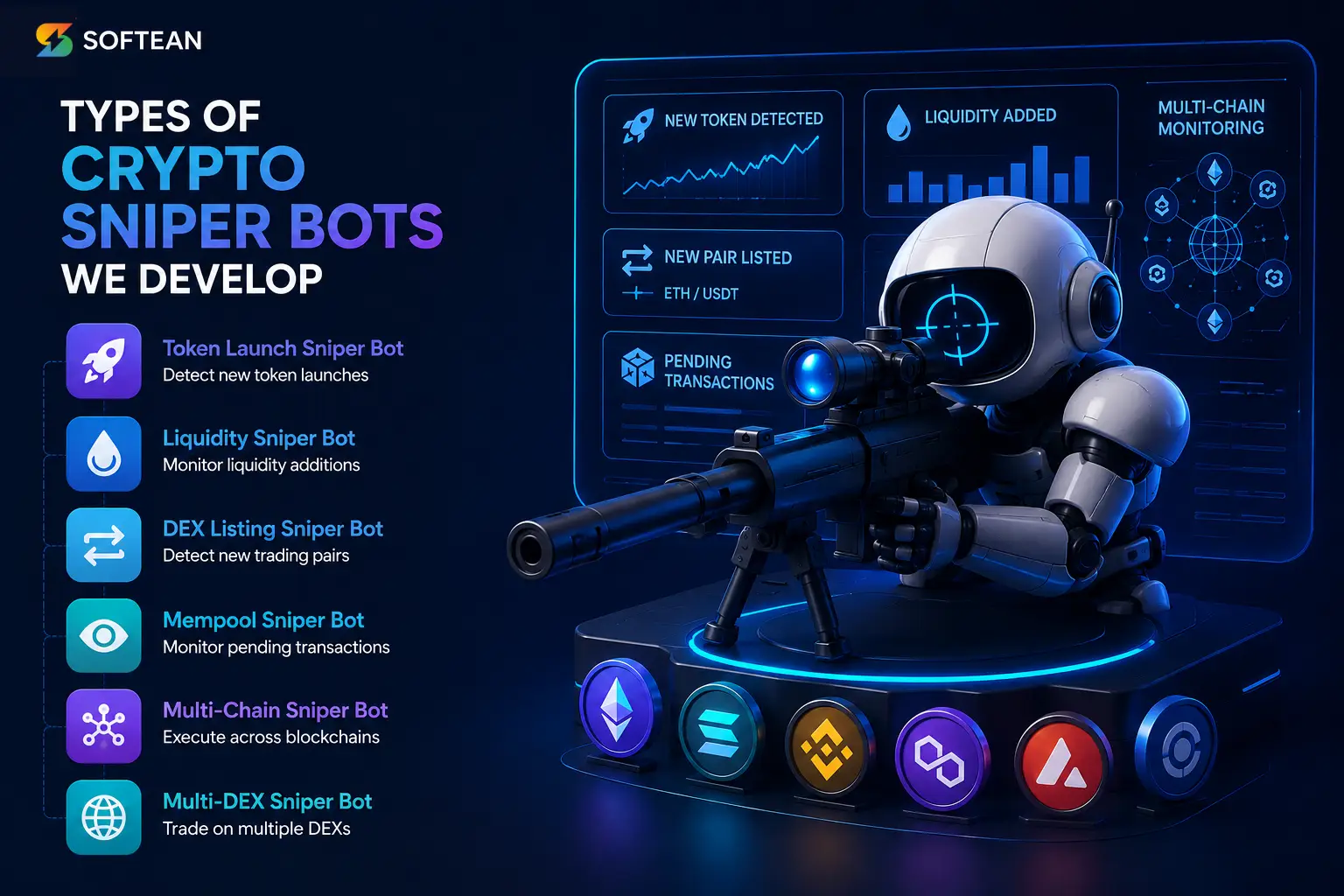
Token Launch Sniper Bot: Detects newly launched tokens and evaluates them based on predefined trading conditions.
Liquidity Sniper Bot: Monitors liquidity additions and identifies potential trading opportunities.
DEX Listing Sniper Bot: Detects newly created or tradable pairs on decentralized exchanges.
Mempool Sniper Bot: Monitors pending transactions for time-sensitive on-chain signals.
Multi-Chain Sniper Bot: Monitors and executes strategies across multiple blockchain networks.
Multi-DEX Sniper Bot: Supports trading opportunities across multiple decentralized exchanges.
How Does a Crypto Sniper Bot Work?
A crypto sniper bot works by continuously identifying predefined trading opportunities and automatically submitting transactions when the criteria are satisfied. The entire process is designed to minimize the time between opportunity detection and trade execution.
The typical workflow can be broken down into the following stages:
1. Real-Time Blockchain Monitoring
The bot continuously monitors relevant blockchain events, DEX transactions, liquidity changes, & other predefined signals. This allows it to detect potential opportunities without waiting for manual market observation.
2. Opportunity Detection
When a relevant event occurs, such as a new token becoming tradable, a liquidity pool being created, or liquidity being added, the detection engine identifies it and passes the information to the next stage.
3. Token and Market Analysis
Before executing any trade, the bot evaluates a few factors such as liquidity, token price, trading conditions, slippage, and other predefined bot parameters. This filtering helps prevent the system from treating every detected event as a valid trading opportunity.
4. Strategy Validation
After that, the strategy engine compares the opportunity against the configured trading rules. These rules may include minimum liquidity, entry price, contract-risk conditions, or other custom criteria. Only opportunities that satisfy the required conditions move forward.
5. Transaction Construction
Once an opportunity passes the strategy and risk checks, the bot prepares the transaction with the required parameters, including wallet details, gas or priority settings, as well as other execution requirements.
6. Automated Transaction Execution
The execution engine submits the transaction through the configured blockchain infrastructure. The objective is to reduce unnecessary delays between identifying a qualifying opportunity and placing the trade.
7. Confirmation and Position Monitoring
After submission, the bot tracks the transaction status and monitors the resulting position. Depending on the strategy, it can apply predefined exit conditions such as take-profit or stop-loss.
These stages operate as a coordinated pipeline rather than as isolated functions. The effectiveness of the bot depends not only on its trading strategy but also on the speed of event detection and risk-management mechanisms.
How Sniper Bots Detect New Token Opportunities?
Instead of relying on manual observation, a sniper bot continuously monitors selected blockchain networks, DEX activity, smart contract events, and other predefined signals to determine whether a newly emerging token or trading event is worth evaluating.
New Token Contract Detection
We help you build a bot that can monitor blockchain activity for newly deployed token contracts and identify contracts that match predefined parameters. Once detected, the token can be passed through additional checks before becoming eligible for trading.
Liquidity Pool Creation
Creating a liquidity pool can signal that a token is preparing to become tradable on a decentralized exchange. A sniper bot can monitor relevant DEX smart contract events, allowing the strategy engine to evaluate the factors.
Liquidity Addition
Existing pools can become attractive when substantial liquidity is added. By monitoring liquidity events, the bot can identify changes that meet the thresholds and determine whether the event represents a potential entry opportunity.
DEX Pair Creation
When a new trading pair is created, a Sniper bot can detect the corresponding on-chain event and collect relevant information about the token pair, then evaluate any specific requirements before considering execution.
Trading Activation
Some tokens may exist on-chain before trading is actually enabled. A sniper bot can monitor smart contract events and transaction activity to enable the system to respond to the transition from a non-tradable state to an active market.
Mempool Signals
Bots can monitor pending transactions for signals associated with liquidity changes, trading activation, or other relevant activities. Mempool monitoring can provide an earlier view of certain events.
External Signals
We also help you build a sniper bot that can incorporate external data sources such as token-launch announcements, social signals, or other configured data feeds. These signals can be combined with on-chain verification, helping the bot identify potential opportunities.
What Makes a Sniper Bot Fast?
In sniper trading, speed is not determined by a single component. A bot can detect an opportunity quickly and still lose its execution advantage if the strategy takes too long to process the signal.
For this reason, an effective sniper bot focuses on optimizing the complete path from opportunity detection to transaction confirmation. The goal for a sniper bot is not simply to make the bot “faster,” but to create a low-latency execution pipeline where every component is optimized to work together.
Event Detection Latency
The first advantage comes from how quickly the bot identifies a relevant event. Real-time listeners, WebSocket connections, and event-driven processing can help reduce the delay between an on-chain event and the bot.
Data Processing Latency
Once an event is detected, the bot must process the incoming data and determine whether it represents a genuine opportunity through efficient data structures, optimized logic, and more. This helps the system analyze signals without introducing unnecessary computational delays.
Strategy Decision Latency
After processing the signal, the strategy engine determines whether the opportunity satisfies predefined conditions through complex rules, risk checks, and contract screening so that additional validation does not unnecessarily compromise execution speed.
Transaction Construction Latency
Once the strategy approves a trade, the bot needs to construct the transaction with the correct parameters. The preconfigured execution logic, like gas configuration, can reduce the time required before submission.
RPC Latency
The connection between the bot and blockchain infrastructure plays a critical role in execution performance. High-performance RPC endpoints and failover infrastructure will reduce the communication delays.
Transaction Propagation Latency
Submitting a transaction is only one part of execution; the transaction must propagate through the relevant network before it can potentially be included in a block. Network connectivity, transaction configuration, and infrastructure quality can influence how efficiently this happens.
Block Inclusion Latency
After propagation, the transaction must be selected for inclusion in a block. Network congestion, transaction competition, gas, and blockchain-specific mechanics can influence how quickly this occurs.
Confirmation Latency
Finally, the system needs to determine whether the transaction was successfully executed and update the trading state accordingly, which helps in monitoring the newly acquired position, triggering an exit strategy, or handling a failed transaction.
This makes low-latency architecture, a reliable blockchain infrastructure, and efficient strategy execution fundamental considerations when building a production-ready sniper bot.
How to Build a Crypto Sniper Bot: Step-by-Step Process
Building a crypto sniper bot requires more than automating buy and sell transactions. The system needs to connect real-time blockchain data with opportunity detection, strategy logic, risk controls, and rapid transaction execution. Here is the step-by-step process to create a sniper bot:
Step 1: Define the Sniping Strategy
Start by determining exactly what the bot should identify and trade. The strategy may focus on new token launches or any other predefined on-chain events, and risk parameters should be clearly defined before development begins, like entry conditions, exit rules, and more.
Step 2: Select the Blockchain and DEXs
Choose the blockchain networks and decentralized exchanges based on liquidity, transaction costs, & target assets. The selected environment determines the bot's architecture and RPC requirements.
Step 3: Develop the Real-Time Detection Engine
Then build an event-driven monitoring layer that continuously tracks relevant blockchains. The detection engine should identify predefined signals quickly and pass validated data to the strategy layer without introducing unnecessary processing delays.
Step 4: Token and Smart Contract Analysis
Before allowing a trade to proceed, the bot can analyze the token contract, trading restrictions, and other risk indicators. This layer helps prevent the system from automatically entering opportunities that fail predefined safety criteria.
Step 5: Develop the Strategy Engine
The strategy engine evaluates detected opportunities against the configured trading rules. It only focuses on considering factors before determining whether the opportunity qualifies for execution.
Step 6: Develop the Transaction Execution Engine
Once an opportunity passes the required checks, the execution engine prepares and submits the transaction to the relevant DEX. Transaction parameters such as trade amount, gas fees, slippage limits, and nonce should be handled efficiently.
Step 7: Implement Risk Management
Then introduce controls that determine how much capital the bot can deploy and under what conditions it can trade. These may include maximum position size, liquidity thresholds, and stop-loss and take-profit rules.
Step 8: Test, Simulate, and Deploy
Before deploying with real capital, the bot should undergo all types of performance and stress testing. After successful validation, the bot can be deployed to production with continuous monitoring and optimization.
This is Softean’s proven process of developing a sniper bot and building reliable infrastructure capable of detecting the right opportunity, making the right decision, and executing according to predefined rules with speed and control.
Technology Stack for Crypto Sniper Bot Development
A crypto sniper bot requires technologies that support real-time blockchain monitoring, low-latency processing, secure transaction execution, and scalable infrastructure. The technology stack can vary based on the target blockchain, DEX integrations, and trading strategy.
Blockchain: Ethereum, Solana, BNB Chain, Base
Frontend: React.js, Next.js
Backend: Node.js, Python, Go, Java
Programming: JavaScript, TypeScript, Rust, Solidity
Blockchain Integration: RPC, WebSocket, JSON-RPC, SDKs
Database & Cache: PostgreSQL, MongoDB, Redis
Infrastructure: AWS, Docker, Kubernetes
The stack is selected based on the bot's execution requirements, supported networks, trading strategies, and scalability needs.
Blockchain Networks for Sniper Bot Development
The choice of blockchain can directly influence a sniper bot's execution speed, transaction costs, DEX availability, and overall trading performance. Different networks have different consensus mechanisms, fee structures, and infrastructure requirements.
Therefore, choosing the right blockchain should be one of the first decisions when building a sniper bot. The selected network should align with the intended trading strategy, target assets, transaction requirements, and execution goals rather than assuming that one blockchain is suitable for every use case.
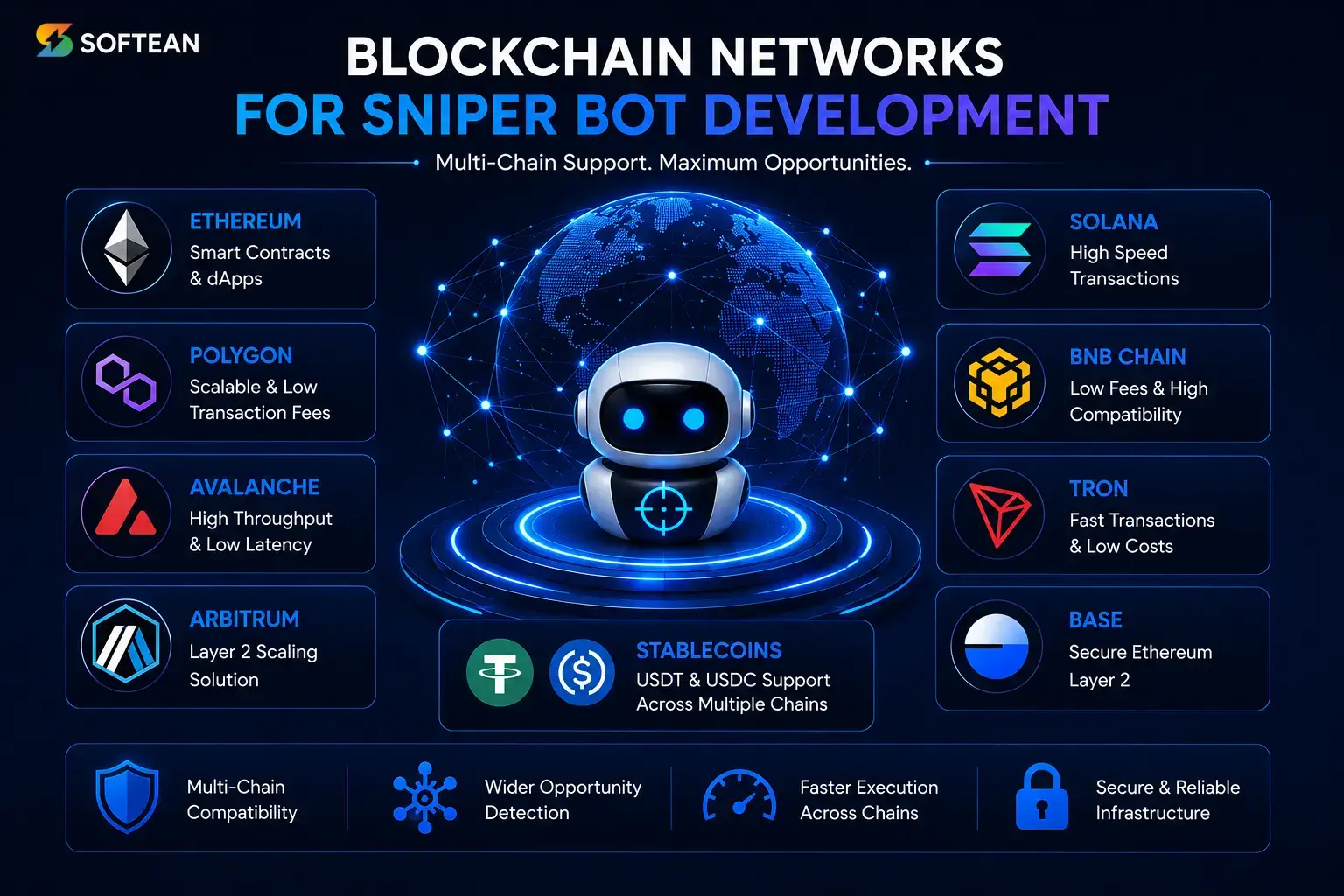
For businesses targeting opportunities across multiple ecosystems, Softean can help you develop a multi-chain sniper bot that connects to several blockchain networks. Our approach combines chain-specific monitoring, transaction execution, and risk controls while maintaining separate execution logic for each network.
Why Choose Softean as Your Crypto Sniper Bot Development Company?
Our crypto sniper bot development focuses on speed, precision, security, and strategy-driven execution. Our expert developers help you develop custom sniper bots tailored to the target blockchain, DEX ecosystem, trading strategy, and business requirements. From real-time opportunity detection to automated transaction execution, our trading bot architecture is designed to support reliable performance.
As a leading crypto trading bot development company, Softean focuses on more than simply automating trades; we build the underlying infrastructure that makes automated execution practical. Our development approach can include multi-chain integration, configurable trading strategies, risk-management mechanisms, and performance-focused execution.
Whether you are planning a single-chain sniper bot or a more advanced multi-chain trading system, we can structure the solution around your specific objectives. With a combination of blockchain expertise and custom software engineering, Softean helps businesses build sniper bots designed for evolving on-chain trading environments.
Frequently Asked Questions
How much does sniper bot development cost?
The cost of sniper bot development typically depends on various factors such as the bot's complexity, blockchain support, DEX integrations, trading strategies, security requirements, and custom features.
A basic sniper bot may start from $10,000–$20,000, while an advanced multi-chain solution and custom strategies can range from $30,000–$80,000+. The final cost varies based on the specific business and technical requirements.
How long does it take to develop a crypto sniper bot?
The development timeline for a crypto sniper bot development project typically ranges from 4 to 12 weeks, depending on the bot's complexity and customization requirements. A basic single-chain bot may take around 3–5 weeks, while an advanced multi-chain solution with custom strategies, multiple DEX integrations, and security controls may require 6–12+ weeks.
What are the challenges in building a sniper bot?
The key challenges in sniper bot development include the following:
- Maintaining low-latency execution
- Handling network congestion
- Managing slippage and liquidity risks
- Detecting malicious smart contracts
- Building reliable RPC infrastructure
- Scalable multi-chain integrations can also add complexity
Softean's well-designed crypto sniper bot development service addresses these challenges through optimized architecture, strong risk controls, and thorough testing.
Are crypto sniper bots profitable?
Crypto sniper bots can be profitable, depending on factors such as trading strategy, execution speed, liquidity, slippage, and risk management. That's where Softean's expertise comes in; we help you build a well-developed bot that can improve execution efficiency and consistency.
How does a sniper bot detect new token launches?
A sniper bot continuously monitors blockchain events, liquidity-pool events, and trading activation signals to identify newly launched or newly tradable tokens. Once a potential launch is detected, the bot can analyze predefined conditions to automate transactions.
Can a sniper bot monitor liquidity additions?
Yes. A sniper bot can continuously monitor liquidity-pool activity and detect when new liquidity is added to a token's trading pair. It can then evaluate factors such as liquidity size, price, and more before automatically executing a trade when the opportunity meets the required criteria.
Which blockchains can support sniper bot development?
Sniper bots can be developed for blockchain networks that support the required DEX and transaction-monitoring capabilities. Common options include Ethereum, Solana, BNB Chain, and Base. We help you choose the right network based on your tailored requirements and specific trading strategy.
Can a sniper bot work with multiple DEXs?
Yes. A sniper bot can be integrated with multiple decentralized exchanges and other on-chain opportunities across different DEXs. Our sniper bot development can also include DEX-specific execution logic, allowing the bot to apply predefined strategies and risk parameters based on the conditions of each exchange.
How does a sniper bot protect against honeypots and malicious contracts?
A sniper bot can integrate automated token and smart-contract analysis to identify potential risks before executing a trade. It can check factors such as buy/sell restrictions, trading limitations, and other predefined risks. These checks can help the bot reject suspicious tokens instead of blindly executing every detected opportunity.
What is the role of mempool monitoring?
Mempool monitoring allows a sniper bot to observe pending transactions for signals related to token launches and other time-sensitive events. By detecting relevant activity before transactions are confirmed on-chain, the bot can evaluate potential opportunities earlier.