The Fiat-to-Crypto Bridge Your Business Is Leaving on the Table
Why a stablecoin payment gateway for businesses, not another crypto exchange app, is the real on-ramp for the next wave of users and how Softean helps you build one.
Picture this
It's 2026, and your average customer still isn't "into crypto." They've never bought a token, never worried about gas fees, and would never describe themselves as a Web3 person. But they do use mobile money to send their sister rent money. They do tap "Pay Now" fifteen times a day without thinking about it. And they'd absolutely say yes to something that quietly grows their money in the background, as long as nobody made them feel stupid for not understanding blockchain first.
That user is sitting inside almost every B2B platform reading this right now. The question isn't whether they'll eventually touch crypto. It's whether your product is the one that gets them there — or whether they'll do it through someone else's app, three years from now, after you've already lost the window.
That's the gap Softean builds for: a stablecoin payment gateway for business that turns fiat-to-crypto conversion into something that feels like a normal part of paying, not a leap of faith.
Why Traditional Crypto On-Ramps Fall Short for Businesses
Most B2B crypto payment solutions on the market today were built for people who already know what a seed phrase is. They assume comfort with wallets, exchanges, and volatility. That's fine for the crypto-native 3% of your user base and completely useless for the other 97%.
A genuinely useful fiat-to-crypto conversion API has to do something harder: disappear. It has to sit inside a payment flow people already trust — a checkout screen, a mobile money app, a loyalty wallet — and just work, the same way a currency conversion at checkout works when you buy something priced in dollars from a European store. No lecture on blockchain required.
What a Modern Stablecoin Payment Gateway Needs
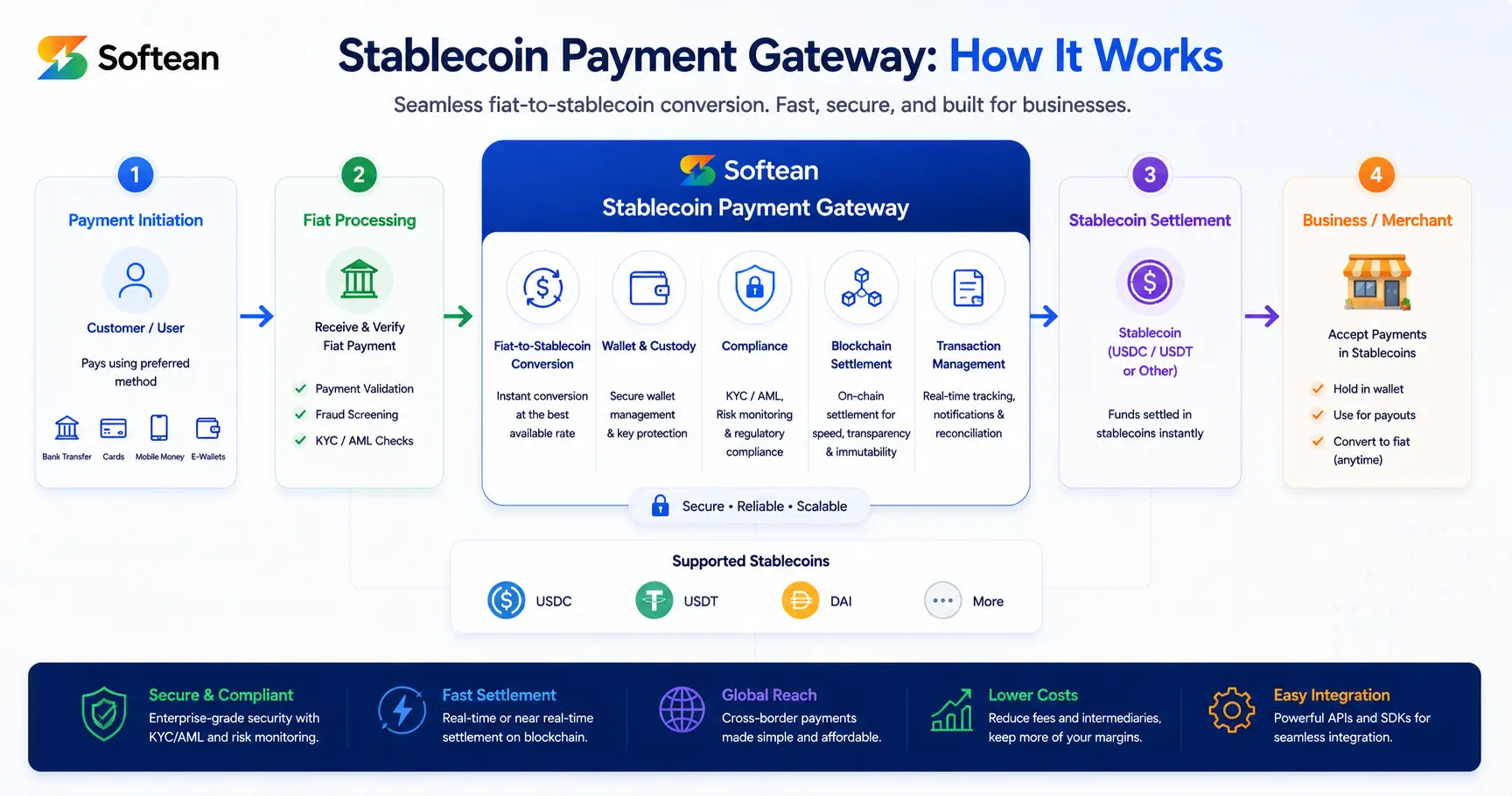
Strip away the buzzwords, and a modern stablecoin infrastructure for fintech platforms needs to do a handful of things really well:
- Convert fiat to stablecoins instantly at the point of payment, so the volatility of crypto markets never becomes the user's problem.
- Give people a path into more, if they want it — established tokens, curated digital assets, even NFTs — without forcing it on the majority who just want stability.
- Serve both worlds on one rail. Crypto veterans get wallet control, on-chain composability, and real market access. Newcomers get something that looks and feels like a normal balance in their app. Nobody has to leave the platform to get what they need.
- Plug directly into mobile money. In markets across Africa, South Asia, and Latin America, mobile money already is the bank. A mobile money crypto integration that lets someone swap fiat for stablecoins from inside their existing wallet — instead of trekking to a physical exchange counter — isn't a nice-to-have. It's the whole product.
Scenario: The Market Trader in Nairobi
Amara runs a stall in Nairobi and already collects payments through mobile money — has done for years. In 2026, her payment app quietly adds a stablecoin option: a portion of what she earns can convert automatically into a stable digital balance she can hold, send across borders to a supplier in Lagos, or cash back out to mobile money whenever she needs shillings. She never opens a crypto exchange. She never learns the word "wallet address." She just notices her supplier payments clear faster and cost less. That's a pocket-based fiat swap doing its job — no exchange counter, no friction, no crypto vocabulary required.
Scenario: The Loyalty App that Quietly Becomes a Wallet
A regional ride-hailing super app wants to boost daily engagement without burning more on paid acquisition. They add a rewards layer: users earn small claimable tokens for verified activity — completing rides, hitting weekly streaks, referring friends — through the same app they already open every day. The rewards accumulate in an in-app wallet built on the gateway underneath. Some users cash out. Some hold. A few get curious enough to explore the broader digital assets available on the platform. The company didn't launch "a crypto product." They launched a loyalty feature that happens to run on real, ownable digital assets — which is exactly why it works.
Scenario: The Fintech that Finally Wins Over its own Power Users
A digital bank in Southeast Asia has spent two years watching its most active users route around them — converting to crypto through third-party apps because the bank never offered it. In 2026, they launch a crypto payment gateway through Softean, and something interesting happens: their crypto-savvy users come back in-house, because the platform now supports the wallet control and market access they actually want, while everyone else keeps using it exactly like they always have. One rail, two audiences, zero users lost to a competitor.
The Engagement Layer, Done Honestly
Here's where it gets fun — and where it's worth being straight with you about what actually works.
Reward mechanics tied to real activity are among the most proven token rewards platforms for business strategies. Think of a simple version: a user's verified steps or completed actions in the app translate into small, claimable token rewards they can collect into a wallet. It's a genuinely strong acquisition loop — people join out of curiosity about the reward, and stay because the payment rail underneath is actually useful to them.
Two honest notes, because you'll build a better product if you hear them now instead of after launch:
- Skip the temptation to describe user rewards using blockchain consensus terms like "proof of stake" or "proof of work." Those describe how validators secure a network — they're not the right words for "you get a token after finishing a walk." Anyone technical in your audience (including the crypto veterans you want on the platform) will notice the mismatch immediately, and it costs you credibility for no upside. Call it what it is: a verified-activity reward, claimed into a wallet.
- A "mystery spin" that surfaces new tokens is a great move-to-earn app development and engagement mechanic — variable rewards are genuinely sticky. But depending on where you're operating, mechanics that resemble a prize draw tied to something of value can brush up against gambling regulation. That's a five-minute conversation with legal before launch, not a blocker to building it.
A version of this product that's precise about what's being rewarded, and how, will outlast a version that oversells the mechanics, because it survives contact with both regulators and your most technically literate users.
Why this Matters for the Business, Not Just the User
For the platform building this, the math is straightforward:
1. Cheaper user acquisition. Reward loops and mystery mechanics are viral by design — they pull people in through curiosity, not ad spend.
2. A new revenue line from conversion spread and transaction fees, stacked on top of whatever you already monetize.
3. Retention that's earned, not forced. A user holding claimable rewards and routing funds through your rail has a daily reason to open the app.
4. A genuine financial inclusion story, especially anywhere mobile money already dominates — this is the rare case where "crypto payment gateway development" and "meaningful product improvement" are the same sentence.
5. One rail, every user. Most fintech products pick a lane: beginner-friendly or crypto-native. A well-built gateway doesn't have to choose — which means your addressable market doesn't shrink to fit the product.
The Investor Angle: Where the Cost Savings Actually Show Up
Everything above is a product story. There's a capital efficiency story sitting right underneath it, and it's the part investors evaluating this category tend to look at first.
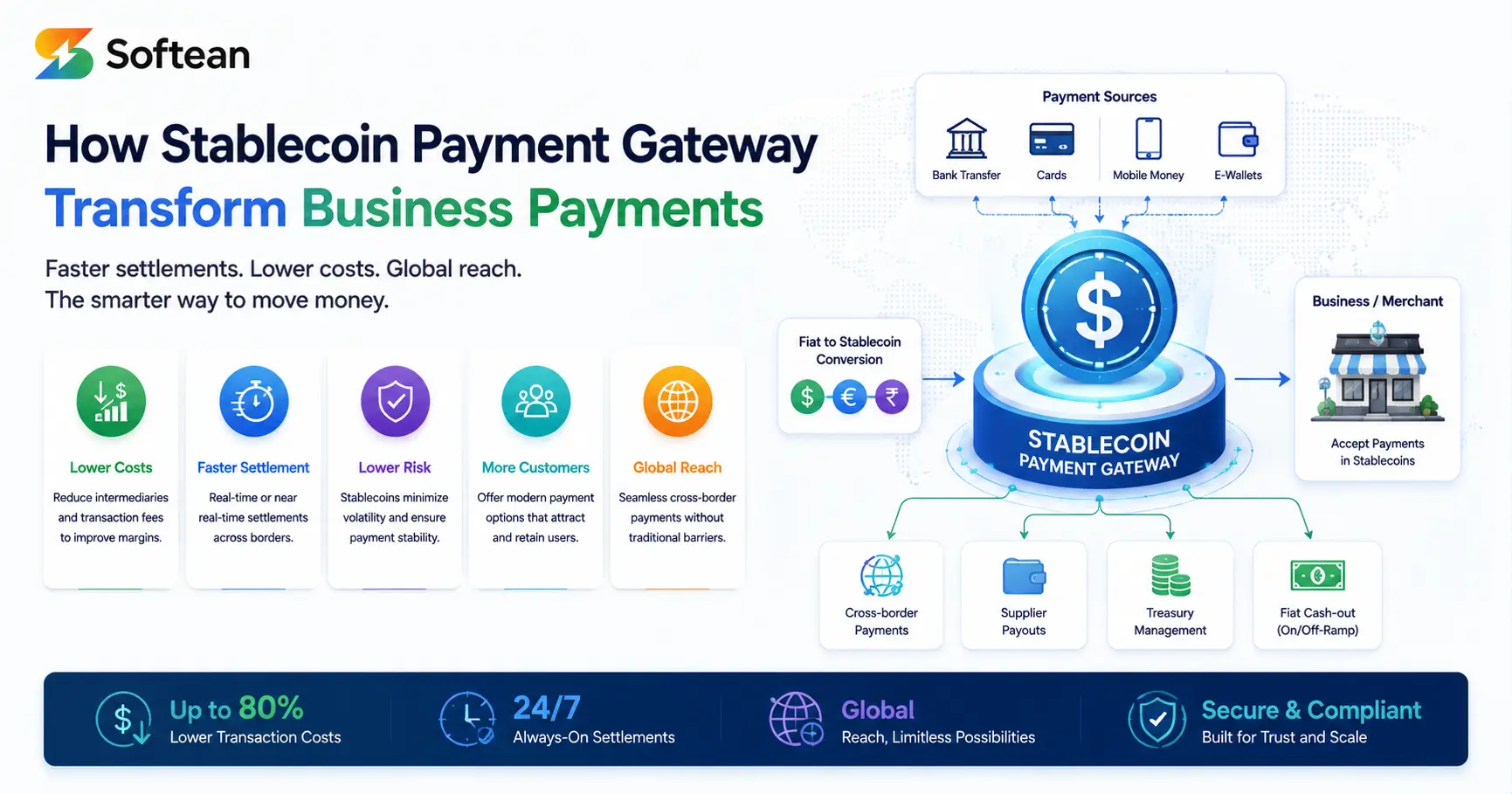
A stablecoin payment gateway for business doesn't just create a better user experience — it restructures the cost base of the businesses running on it, in ways that show up directly in the metrics investors care about:
- Settlement costs drop. Card network interchange typically runs 2–3% per transaction, and cross-border remittance fees can run several times higher than that once correspondent banks are involved. Routing settlement through stablecoins instead cuts out several of those intermediaries, which shows up as wider margins for any business processing volume through the rail — not a one-time saving, but a permanent shift in unit economics.
- Time-to-market and build cost fall. A business that would otherwise spend six to twelve months and a multi-person engineering team building wallet infrastructure, custody, and mobile money integrations from scratch can instead plug into shared, white-label infrastructure. For investors, that's a shorter runway to revenue and a smaller capex line before the product is even live.
- Customer acquisition cost improves. The reward and engagement mechanics covered earlier aren't just a user-facing feature — they're a CAC lever. A platform pulling in users through activity-based rewards and referral loops, instead of paid acquisition, tends to show a healthier LTV: CAC ratio, which is one of the first things a growth-stage investor will ask about.
- Compliance overhead is absorbed into the infrastructure, rather than built and staffed separately by every business that adopts it. KYC, transaction monitoring, and jurisdiction-specific mobile money compliance are expensive to build once and re-use, and prohibitively expensive to rebuild per client.
- Idle treasury reserves can be put to work. Funds held in stablecoins as working capital don't have to sit static — depending on the custodial and regulatory setup, they can be structured to generate yield rather than earning nothing, which is a detail investors will want modeled explicitly rather than assumed.
For investors, the way to think about this category isn't "a crypto feature bolted onto a business." It's infrastructure that lowers the cost of running a payments or loyalty product at scale, in a market (stablecoin settlement, mobile money rails) that's already moving from early-adopter to mainstream. The businesses worth backing here are the ones that can show the cost curve moving — narrower spread on settlement, lower CAC, faster build cycles — not just a token launch and a growth chart.
(This is a description of how the cost structure works, not investment advice or a return projection — every jurisdiction, custodial arrangement, and token structure carries its own regulatory and financial risk, and that diligence is worth doing with qualified legal and financial counsel before any capital commitment.)
Why 2026 is the Year to Move
Stablecoin payment processing for enterprises has gone from experimental to core infrastructure — real settlement volume, real regulatory clarity taking shape in major markets, real institutional interest. Mobile money has already proven, over more than a decade, that people don't need a bank branch to trust a digital balance. And activity-based rewards remain one of the strongest engagement levers in the industry, provided they're built with the lessons of the last cycle's move-to-earn boom-and-bust actually applied, not ignored.
The opportunity in front of you isn't "bolt crypto onto your app." It's building the rail that makes crypto disappear into the background of a payment experience your users already trust — so well that they never think to call it crypto at all.
Where Softean Comes in
This is infrastructure work — stablecoin payment gateway architecture, mobile money integrations across jurisdictions, wallet and custody design, and reward-token issuance built to survive regulatory review, not just look good in a pitch deck. That's the layer Softean, the leading Stablecoin development company, builds for partners who want to own this category rather than rent it from someone else's platform.
If your business already sits on top of a payment flow, a loyalty program, or a mobile-first user base, the real question isn't whether stablecoin-native rails are coming to your space. It's whether you're the one who builds it first.
Thinking about what a stablecoin payment gateway for business could look like on your platform? Talk to Softean's team about scoping it.