The cryptocurrency market relies on strong infrastructure. While coins like Bitcoin and Ethereum often make the news, exchanges are the real drivers, handling billions in trades every day and connecting buyers and sellers worldwide.
Exchanges have come a long way since the days of BitcoinMarket.com. Today, major platforms like Binance and Coinbase are complex financial systems that handle trading, asset storage, compliance, and real-time data.
For entrepreneurs, starting a crypto exchange is more than joining a popular trend. It means building a financial platform that runs smoothly, remains secure, and scales with growth around the clock.
To start a crypto exchange, you need to define your business model, choose an exchange type, establish a compliance strategy, build the technology infrastructure, integrate liquidity and payment systems, implement security measures, test the platform, and launch with a scalable growth plan.
Our guide explains how to start a crypto exchange, covering strategy, technology, and operations. It will help you turn your idea into a working business.
Crypto Exchange Market Overview
The global cryptocurrency market is still seeing tremendous growth.
Key Industry Statistics
- As of 2026, the number of people worldwide owning crypto exceeded 560 million.
- During major market cycles, the global cryptocurrency market cap has surpassed $3 trillion. This shows the industry's potential for long-term growth.
- Daily cryptocurrency trading volumes regularly reach between $100 billion and $300 billion across the globe’s exchanges.
- Bitcoin and Ethereum still dominate trading activity, but altcoins and tokenized assets are creating new opportunities in the market.
- Institutional adoption of digital assets continues to grow with ETFs, custody solutions, and financial products on the blockchain.
These trends indicate strong market demand for secure, scalable, and feature-rich crypto exchanges.
What is a Crypto Exchange and How Does it Work?
A cryptocurrency exchange is a digital marketplace where users trade crypto assets against other cryptocurrencies or fiat currencies.
At a system level, an exchange operates through a coordinated set of components:
- Order submission layer where users place buy or sell orders
- Matching engine that pairs orders based on price and time priority
- Liquidity layer that ensures trades can be executed instantly
- Wallet infrastructure for asset custody and transfers
- Settlement system that finalizes transactions
Unlike traditional stock exchanges, crypto platforms must handle:
- 24/7 global trading activity
- High volatility and traffic spikes
- Multi-chain asset management
Because of these factors, building a crypto exchange is much more complicated than creating a typical fintech platform.
Types of Crypto Exchanges and Strategic Trade-offs
Selecting the right type of crypto exchange is a crucial foundation for your business. Each model presents unique trade-offs in security, liquidity, control, and scalability that directly impact your platform’s success.
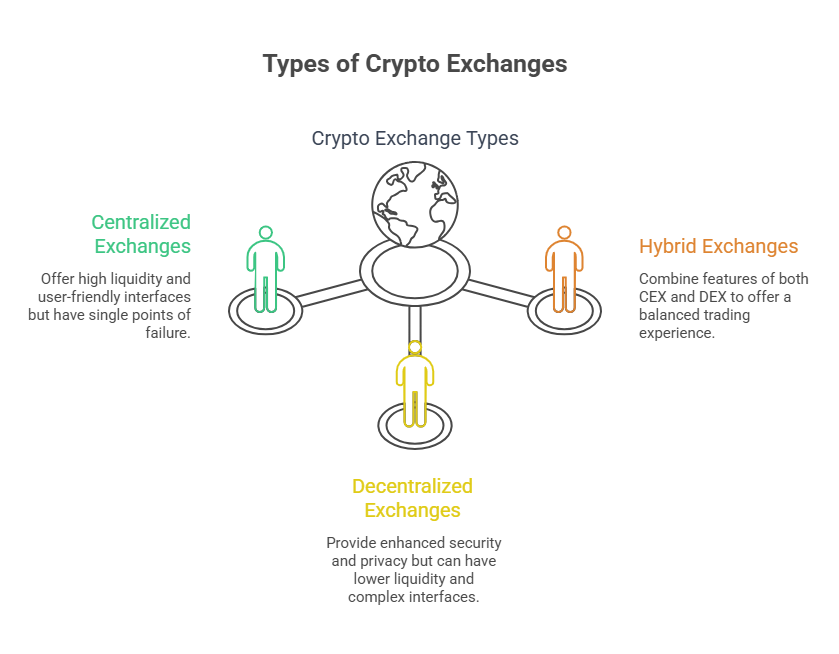
Centralized Exchanges (CEX)
Centralized exchanges are the most common type of crypto exchange, managed by a single authority. They act as intermediaries between buyers and sellers, facilitating transactions while providing a user-friendly interface.
Centralized exchanges dominate the market due to their high liquidity, fast execution speeds, and seamless fiat integration, making them the preferred choice for both beginners and professional traders.
Key Features of CEX
User Accounts: Users are required to create accounts and complete identity verification to access trading functionalities.
Liquidity: High liquidity is maintained due to a large and active user base.
Trading Pairs: A wide range of trading pairs is available, allowing users to trade multiple cryptocurrencies.
Advantages of CEX
Ease of Use: Intuitive and user-friendly interfaces make trading simple, especially for beginners.
Customer Support: Most centralized exchanges provide dedicated customer support for issue resolution.
Advanced Features: Many platforms offer advanced trading tools such as margin trading, futures, and analytics.
Disadvantages of CEX
Security Risks: Centralized control makes these platforms attractive targets for cyberattacks.
Regulatory Compliance: Exchanges must comply with regional regulations, which may restrict access in certain locations.
Custodial Risk: Users do not have direct control over their private keys, as funds are held by the exchange.
Top platforms like Binance handle millions of transactions per second using highly optimized matching engines, showcasing the scalability and performance of centralized systems.
Trade-off:
You must handle custody, compliance, and security yourself, which makes the technical and regulatory requirements more challenging.
Decentralized Exchanges (DEX)
A decentralized exchange operates without a central authority, enabling users to trade cryptocurrencies directly with one another through smart contracts. These platforms eliminate intermediaries and provide greater transparency by recording all transactions on the blockchain.
Decentralized exchanges are preferred by users who prioritize privacy, security, and full control over their assets. Since users retain ownership of their funds, there is no centralized custody risk, and all operations remain transparent and verifiable on-chain.
Key Features of DEX
Peer-to-Peer Trading: Users can trade directly with each other without relying on intermediaries.
No Registration Required: Most DEX platforms allow trading without account creation or identity verification.
Smart Contracts: All transactions are executed automatically through secure and transparent smart contracts.
Advantages of DEX
Privacy: Users maintain control over their funds and personal data, ensuring enhanced privacy.
Security: Reduced risk of large-scale hacks, as funds are not stored in a centralized system.
Global Access: Accessible from anywhere without strict geographical restrictions.
Disadvantages of DEX
User Experience: Interfaces can be complex and less intuitive, especially for beginners.
Lower Liquidity: Trading volumes are often lower compared to centralized exchanges.
Limited Features: Fewer advanced trading tools, such as margin trading or derivatives.
Trade-off:
However, DEXs usually have lower liquidity and do not perform as well as centralized exchanges.
Hybrid Exchanges
Hybrid exchanges combine the strengths of both centralized and decentralized exchanges, aiming to deliver the best of both worlds. They are designed to offer the speed and liquidity of centralized platforms while maintaining the security, transparency, and user control found in decentralized systems.
By integrating centralized order matching with decentralized asset custody, hybrid crypto exchanges attempt to overcome the limitations of traditional exchange models while enhancing overall performance and trust.
Key Features of HEX
Centralized Order Book: Utilizes a centralized matching engine for faster trade execution while allowing users to retain control of their funds.
Enhanced Security: Combines advanced security protocols with decentralized fund management to reduce risks.
User-Friendly Interface: Designed to provide a seamless and intuitive trading experience for all types of users.
Advantages of HEX
Flexibility: Users can benefit from both centralized efficiency and decentralized control.
Improved Security: Minimizes custodial risks while maintaining high liquidity.
Advanced Trading Features: Supports sophisticated tools similar to centralized exchanges.
Disadvantages of HEX
Complexity: The hybrid model can be more complex to build and use compared to pure CEX or DEX platforms.
Regulatory Challenges: May face increased regulatory scrutiny due to its dual nature.
Limited Adoption: Still an emerging model with fewer platforms compared to established exchanges.
This approach is becoming more popular, but it needs a more advanced system design.
Core Architecture of a Cryptocurrency Exchange Platform
Building a crypto exchange is mainly about designing the right systems. Every part needs to be built for speed, reliability, and security.

1. Matching Engine
The most critical component.
- Processes buy and sell orders in real time
- Must handle extremely high throughput with minimal latency
- Often built using in-memory processing for speed
Even tiny delays can affect trades, especially when the market is moving quickly.
2. Order Book Management
Maintains a live record of:
- Active buy and sell orders
- Price levels and market depth
This system needs to update all the time without slowing down.
3. Wallet and Custody System
A secure crypto wallet architecture typically includes:
- Hot wallets for real-time transactions
- Cold wallets for offline storage
- Multi-signature or MPC systems for key management
How you design security in this area will directly affect how much users trust your platform.
4. Liquidity Infrastructure
Liquidity determines whether users can trade efficiently.
New exchanges typically rely on:
- Market makers
- Liquidity aggregation APIs
- External exchange integrations
If your platform lacks liquidity, users will leave, no matter how good the technology is.
5. API Layer
Modern exchanges are API-first systems.
- REST APIs for account and transaction management
- WebSocket APIs for real-time trading data
Institutional traders and algorithmic systems depend heavily on API reliability.
6. Admin and Monitoring Systems
Includes:
- Risk management dashboards
- Transaction monitoring tools
- Compliance reporting systems
Being able to see and manage your operations is key to growing your exchange.
Why Start a Crypto Exchange Business?
Starting a crypto exchange platform offers multiple revenue opportunities and long-term growth potential.
Growing Market Demand
- Crypto users are growing year after year.
- By 2030, industry analysts believe there could be more than one billion people with digital assets around the world.
This creates significant demand for:
- Secure trading platforms
- Institutional trading solutions
- Regional crypto exchanges
- Niche exchanges
- White label exchange solutions
Multiple Streams of Income
Unlike many software businesses, exchanges make money from multiple different channels at the same time.
Trading Fees
- The main source of exchange revenue.
- Most exchanges charge between 0.05 percent and 0.5 percent per trade.
Withdrawal Fees - Charged when users take assets out of the platform.
Listing Fees - Exchanges charge projects to list new cryptocurrencies.
Market Making Services - Premium liquidity services provide additional income.
Staking Commissions - Exchanges retain a percentage of staking rewards.
Futures and Margin Trading - Advanced trading products generally offer better profits than spot trading.
Scalable Business Model
Once launched, exchanges can scale globally by adding new markets, cryptocurrencies, and financial products.
Rising Interest from Investors
Venture capital firms and institutional investors continue to invest in crypto infrastructure companies.
How to Start a Crypto Exchange in 2026: Step-by-Step Roadmap
The successful launch of a crypto exchange requires a structured approach that includes planning, strategy, legal compliance, and robust technical development. Here is a step-by-step guide to starting your cryptocurrency exchange in 2026.
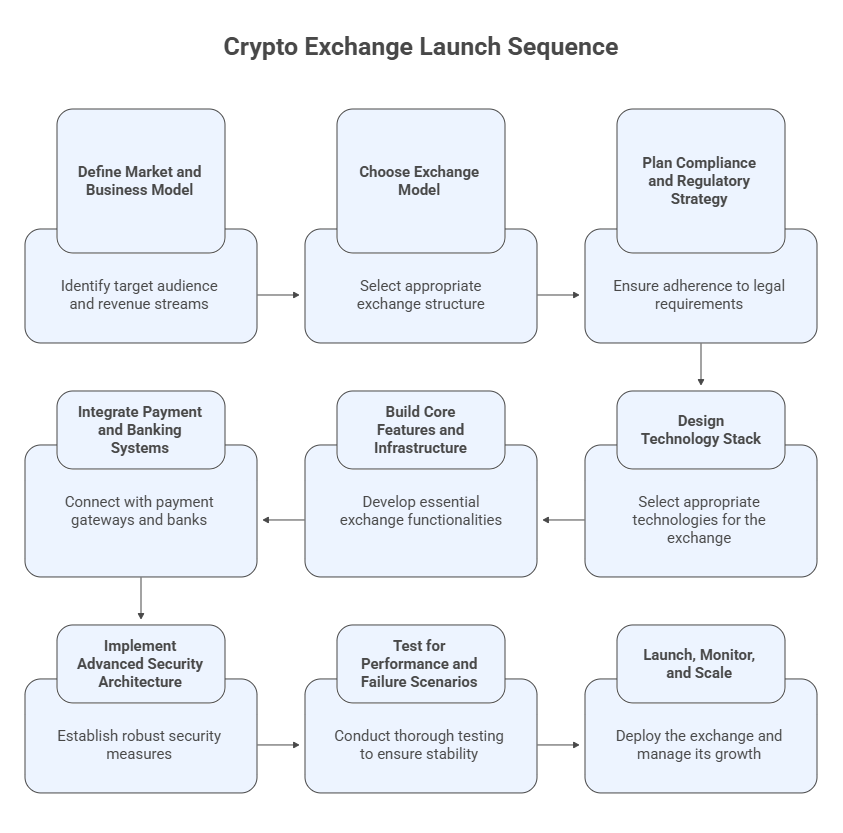
Step 1: Define Your Market and Business Model
Before beginning development, clearly define your operational scope. This foundational step impacts your system architecture, latency requirements, compliance setup, and infrastructure costs.
Choose your Target Audience
Retail users need a simple interface, quick onboarding, and support for fiat payments. Institutional users look for low-latency APIs, FIX protocol support, advanced order types, and detailed reporting.
If you want to support institutions, you’ll often need to design your platform to have latency under 50ms and provide stable WebSocket feeds.
Make your Asset Selection
Spot trading (like BTC/USDT or ETH/USDT) is the easiest place to start. If you add derivatives such as futures or perpetual contracts, you’ll face more complexity, including margin engines, risk calculations, liquidation logic, and funding rate systems.
Determine your Revenue Model
Decide early on whether your platform’s revenue will come from maker/taker fees, listing fees, withdrawal fees, or API subscriptions.
If you plan to offer tiered fee structures, like volume-based discounts, you’ll need extra backend logic connected to user activity and account levels.
These choices will affect your database structure, how your services interact, and how your system handles heavy traffic.
Step 2: Choose the Right Exchange Model
The exchange model you choose will determine how trades are handled on your platform, how funds are managed, and how complex your infrastructure becomes.
Below are a few models to base your platform on:
Centralized Exchange (CEX)
In this model, trades are matched off-chain with a high-speed matching engine.
It will require:
- Internal ledger system (Preferably in PostgreSQL, CockroachDB)
- High-performance matching engine (Go or C++)
- Custodial wallet infrastructure
Key advantages of this model include high throughput, better user experience, and easier liquidity onboarding.
Decentralized Exchange (DEX)
In this model, trades happen through smart contracts that use AMM models, such as Uniswap.
It will require:
- Smart contracts (Use Solidity to write your contracts)
- Web3 integrations (Ethers.js, Web3.js)
- On-chain transaction handling
The trade-offs in this model are slower execution, higher gas costs, and less control over the user experience.
Hybrid Exchange
This model combines off-chain order matching with on-chain settlement.
This approach offers a balance between speed and transparency, but it also means your system will be more complex to manage.
Most companies begin with CEX or hybrid models since these allow faster entry to the market and give you more control over liquidity and user experience.
Step 3: Plan Compliance and Regulatory Strategy
You should build compliance into your system from the start, rather than adding it later, as it may attract regulatory scrutiny at later stages.
Rather than building your own verification systems, use reliable third-party APIs like:
KYC / Identity Verification
Use providers like Sumsub or Onfido for:
- Document verification
- Facial recognition and liveness checks
- Automated onboarding workflows
AML & Transaction Monitoring
Use tools like Chainalysis or Elliptic to:
- Screen wallet addresses
- Detect suspicious transactions
- Flag high-risk activity in real time
Jurisdiction Strategy
Apply for VASP (Virtual Asset Service Provider) licenses in crypto-friendly jurisdictions such as Lithuania or the UAE (VARA).
Your platform must support the following:
- Global Geo-restrictions
- Tiered verification levels
- Audit logs and reporting
Compliance requirements directly influence onboarding flows, database architecture, and transaction handling.
Step 4: Design the Technology Stack
Build your exchange using a distributed, microservices architecture for resilience and scalability.
Our recommended stack would be as follows:
For the Backend Systems
- Go (Golang) for high-concurrency services.
- Java (Spring Boot) for enterprise-grade APIs
- Node.js for orchestration layers
For the Matching Engine
Matching engines are usually built in C++ or Go to achieve ultra-low latency, with execution times under a millisecond.
For the Frontend
- React.js for web trading interface
- Flutter for cross-platform mobile apps.
For the Communication Layer
- WebSockets (WSS) for real-time price feeds and order updates
- gRPC for internal service-to-service communication
For the Data Layer
- PostgreSQL for transactional data
- Redis for in-memory order book and caching
- Kafka for event streaming
For the Blockchain Integration
Connect to networks such as Ethereum or Polygon via providers like Alchemy or Infura.
This recommended architecture maximizes system availability, fault isolation, and scalability, especially under heavy trading loads.
Step 5: Build Core Features and Infrastructure
When developing your MVP, prioritize stability and reliability in the core system. Below are the core features you should focus on in the initial phases of development:
Robust Matching Engine
The core trading system that processes buy and sell orders.
The platform should support:
- Market orders
- Limit orders
- Stop-loss orders
Your target throughput should be around 50,000–100,000+ TPS
Order Book System
Use Redis for in-memory storage to provide real-time updates via WebSockets.
Internal Ledger System
Tracks user balances, trades, and fees.
It needs to be consistent, easy to audit, and able to handle failures.
Wallet Infrastructure
Wallet infrastructure is an essential part of any exchange. Businesses often use secure wallets through specialized Crypto Wallet Development Services to ensure asset security and smooth transactions.
- Hot wallets for active transactions
- Cold storage for long-term asset protection
Charting and Market Data
Integrate TradingView Charting Library for advanced charts and indicators.
Our absolute recommendation is to prioritize reliability above all else. Add new features only after confirming system stability and user demand.
Step 6: Integrate Payment and Banking Systems
A fiat gateway integration is crucial for onboarding and growing your user base across the mass public audience.
Crypto On/Off Ramps
Connect with providers like MoonPay, Banxa, or Stripe Crypto Onramp so users can buy crypto with cards or Apple Pay.
Banking APIs
Use Plaid (US) for bank connections or similar regional providers for ACH/SEPA transfers.
Stablecoin Support
Supporting USDT and USDC helps you rely less on traditional banks.
Processing Layer
Use webhook systems and message queues, such as Kafka, to process transaction confirmations in the background.
Banking integrations can take months because of compliance checks, so start this process as early as possible.
Step 7: Implement Advanced Security Architecture
Treat security as a continuous process at every layer of your platform.
For Custody Solutions
Use Fireblocks or Copper for MPC-based wallet infrastructure to remove the risk of a single private key being compromised.
For Storage Strategy
Keep about 95% of assets in cold storage and 5% in hot wallets.
For User Security, use the following
- 2FA using Twilio Authy
- Device fingerprinting
- Session management
For Infrastructure Security
- DDoS protection (Cloudflare Magic Transit)
- WAF and rate limiting
For Monitoring
Use tools like Datadog or Splunk for real-time anomaly detection.
Incidents like the recent hacks of Mt. Gox and WazirX underscore the importance of a strong security architecture for maintaining the credibility of your crypto exchange.
Step 8: Test for Performance and Failure Scenarios
Your platform’s security testing must simulate real-world stress conditions and attack scenarios.
Load Testing
Use tools like Apache JMeter or Locust to simulate traffic at ten times your expected load.
Stress & Failure Testing
Simulate:
- Server crashes
- Network latency
- Blockchain delays
Security Testing
Run penetration tests or start a bug bounty program using platforms like HackerOne.
Shadow Testing
Test your matching engine with live market data from Binance APIs, but don’t execute trades. This helps you check performance during volatile conditions.
Your platform needs to stay stable during extreme market events, not just under normal conditions.
Step 9: Launch, Monitor, and Scale
Execute a phased launch to minimize risk and maintain system integrity.
Below are some of our recommendations during the launch phase:
Use Controlled Rollout
- Launch with a beta testing round with a sizeable batch of beta users for early feedback on bugs and performance
- Use a limited number of trading pairs during this phase.
- Use gradual onboarding methods for public launch
Liquidity Seeding
Use APIs from providers such as AlphaPoint or B2Broker to fill your order books.
Monitoring Stack
- Datadog / New Relic for performance tracking
- Prometheus + Grafana for metrics
Customer Support Systems
Use Zendesk or Intercom to handle user queries during peak activity.
Post-launch success depends on your ability to monitor, adapt, and scale based on real user data and feedback.
Scalability Considerations for Crypto Exchanges
To handle growth, exchanges must be built for scale from day one:
| Component | What It Means | Why It Matters |
| Microservices Architecture | Breaks the platform into smaller independent services (trading, wallets, user management) | Allows each component to scale separately and reduces system-wide failures |
| Event-Driven Systems | Uses message queues (Kafka, RabbitMQ) to process events asynchronously | Ensures smooth handling of high-volume transactions without bottlenecks |
| Horizontal Scaling | Adds more servers instead of increasing the power of a single server | Helps manage sudden traffic spikes during high market volatility |
| Real-Time Analytics | Monitors system metrics like trade volume, latency, and errors in real time | Enables faster decision-making and immediate issue detection |
| Performance Metrics | Focus on latency, uptime, and throughput | Directly impacts user experience, trust, and platform reliability |
Key Insight: If your exchange slows down during peak trading hours, users will immediately move to faster platforms.
Building for scalability is not optional in today’s competitive market. If you are planning long-term growth, explore practical strategies on how to scale your crypto exchange business effectively.
Legal Requirements for Starting a Cryptocurrency Exchange
The legal landscape for cryptocurrency exchanges is complex and varies across regions. If you are operating in Europe, you need to comply with the MiCA financial frameworks to get access to the EU markets. Regulations around digital assets keep evolving, making a compliance-ready platform a critical part of launching and operating a successful exchange.
Also, other regions, like Southeast Asia, Western Asia, and Australia, are still in the evolving phase. Obtaining the appropriate licenses and meeting the regulatory requirements is essential not only for legal operation but also for building trust among users.
Licensing and Registration
Before launching your crypto exchange, you must obtain the necessary licenses and registrations to operate with financial authorities in your chosen region. The requirements vary based on the jurisdiction, and top region like the USA, UK, and Japan has the robust frameworks.
Jurisdiction Selection
As we discussed, regulations differ significantly between countries. Some regions offer clear frameworks that support crypto businesses, while others impose strict restrictions. For example, Singapore and Malta have clear legal structures, but Qatar has strict restriction policies for trading digital assets.
KYC Compliance
Know Your Customer (KYC) compliance focuses on verifying user identities during the onboarding process. This includes document verification, identity checks, and user authentication to ensure that only legitimate users are able to access your platform.
AML Measures
Anti-Money Laundering (AML) measures involve continuously monitoring transactions and detecting suspicious activities. These systems help identify potential financial crimes, flag high-risk behavior, and ensure that your platform complies with global financial regulations to mitigate fraud risks and enhance overall market integrity.
Security and Consumer Protection
Most countries' regulations often require strong security measures within your platform, such as fund segregation, cold storage, multi-signature wallets, and regular audits. Also, transparent policies and user protection mechanisms are essential to maintaining security measures and boosting user trust.
Reporting and Ongoing Compliance
Compliance is not a one-time process. Your platform must perform regular audits to keep up with the evolving laws and submit reports to authorities to remain legally operational. This will help you prevent penalties to enhances your business reputation.
A well-defined legal strategy not only ensures compliance but also strengthens your platform’s credibility in a highly competitive market. Exchanges that prioritize regulatory alignment from the beginning are better positioned to scale globally and also gain long-term user trust and retain users.
A secure and compliant exchange must include:
| Area | What It Includes | Why It Matters |
| KYC & AML Systems | User identity verification and anti-money laundering checks | Prevents illegal activity and ensures regulatory compliance |
| Transaction Monitoring | Real-time tracking of suspicious activity and fraud patterns | Helps detect and prevent fraudulent transactions early |
| Key Management | Secure storage using MPC (Multi-Party Computation) or HSM (Hardware Security Modules) | Protects private keys, which are the most critical assets |
| Security Audits | Regular internal and third-party penetration testing | Identifies vulnerabilities before attackers do |
| Data Protection | Encryption of user data and secure storage practices | Ensures privacy and builds user confidence |
Key Insight: Security is not just about protection, it is a major factor in building long-term user trust and platform credibility.
Key Challenges in Starting a Crypto Exchange
Building a crypto exchange goes far beyond developing a trading platform, it involves navigating a complex mix of technology, security, and regulatory demands. Understanding these challenges early allows businesses to plan effectively and avoid costly mistakes.
1. Regulatory Complexity
Crypto exchanges operate with different KYC/AML requirements across different jurisdictions. Licensing a crypto exchange usually takes between 6-12 months based on the complexities put forth by the zones of incorporation. Global crypto exchange compliances are hugley dependent on travel rule compliance, MiCA compliance, MAS Compliance, and the most famous VARA Compliance.
2. Liquidity Acquisition
Liquidity will play a crucial role in defining the volume of users actually using the crypto exchange. Crypto liquidity API providers integration can be a huge investment to get up and running an exchange. Market making, cross-exchange liquidity aggregation, and global liquidity pools significantly form the basis of complexity for businesses to run their own crypto exchange.
3. Security Risks
The crypto exchange architecture and ops section has a direct impact on security and breaches associated with any crypto exchange business. Multi-layer crypto exchange security is impacted through the cold storage functionality and the MPC wallet modes. Security risks in crypto trading platforms can be lethal when there is an interference of AI-driven fraudulence.
4. Market Competition
GTM will be a primary challenge in running the crypto exchange. Crypto exchange businesses have to take part in competition directly with the existing businesses, such as Binance and Kraken. Proof of reserves, transparency, and user education help businesses compete with global giants. But the challenge lies in identifying the ideal USP of this saturated exchange market.
5. User Experience
User experience also faces challenges in terms of providing usability to different users. Users from all classes, right from beginner to pro-level traders, interact with this section of the crypto exchange. This has to be made available, catering to the needs of all classes of audience with rate optimization, onboarding flow, and mobile friendliness, which again is a huge challenge.
How Much Does it Cost to Create a Crypto Exchange?
The cost of building a crypto exchange varies based on your platform’s complexity, feature set, and regulatory scope. Rather than just giving a fixed number, it is better understood through the key factors that influence development. For a more detailed breakdown, you can explore our complete guide on the cost to start a cryptocurrency exchange.
Key Cost Drivers
| Factor | What It Impacts |
| Exchange Type | CEX, DEX, or hybrid models affect system complexity and infrastructure |
| Feature Scope | Basic and advanced trading features like derivatives, staking, or margin trading |
| Technology & Infrastructure | Matching engine performance, APIs, cloud scaling, and databases |
| Security & Compliance | KYC/AML integration, audits, wallet security, and monitoring systems |
| Liquidity Integration | Market makers, liquidity APIs, and external exchange connectivity |
Types of Crypto Exchanges and Their Development Costs
The cost of developing a crypto exchange varies based on the platform type, complexity, trading features, security requirements, and blockchain integrations. Below is a comparison of the most common crypto exchange types, along with their estimated development timelines and costs.
| Exchange Type | Development Timeline | Estimated Development Cost |
| Centralized Exchange (CEX) | 4 to 8 Months | $50,000 to $500,000+ |
| Decentralized Exchange (DEX) | 3 to 7 Months | $30,000 to $300,000+ |
| Hybrid Exchange | 6 to 12 Months | $80,000 to $500,000+ |
| P2P Crypto Exchange | 4 to 6 Months | $30,000 to $150,000+ |
| Derivatives Exchange | 8 to 14 Months | $60,000 to $750,000+ |
| OTC Crypto Exchange Platform | 4 to 8 Months | $40,000 to $200,000+ |
Cost Breakdown by Development Approach
Before choosing the right approach, it is important to understand the differences between white-label and custom crypto exchange development, as each model impacts cost, scalability, and time to market.
Custom Development
A custom development approach helps you build a tailored crypto exchange from scratch. This approach offers the maximum flexibility in your project but also comes with a high cost. The price can range from $50K to $500K, including custom infrastructure and security, compliance experts, and a dedicated development team.
White-Label Solution
The white-label crypto exchange is pre-built software that gives flexibility to customise for your own rebrand. This approach will drastically reduce the upfront cost. With this model, you will be able to start an exchange from $20,000 to $50,000, based on the customization that your platform needs.
Hybrid Model
Hybrid development models will offer a balance by allowing you to selectively customize without building everything from scratch, combining white labelling with custom features. This model gives you a balanced approach of speed and cost, with a typical cost range between $40,000 – $120,000+.
In addition to development costs, businesses must also account for ongoing expenses such as liquidity integration, infrastructure maintenance, and compliance operations, which can add substantial yearly costs.
Crypto Exchange Business Models and Revenue Streams
A successful crypto exchange relies on well-defined business models and diversified revenue streams. Understanding key income sources such as trading fees and listing charges early on is essential for ensuring long-term sustainability, consistent growth, and profitability.
According to recent data, the total crypto market capitalization is back above the $2.5 trillion mark, even amid market fluctuations, highlighting the scale and resilience of the industry.
In addition to market size, trading activity continues to generate massive liquidity, with daily volumes often reaching tens of billions of dollars. This level of activity creates significant revenue potential for exchanges through trading fees and value-added services.
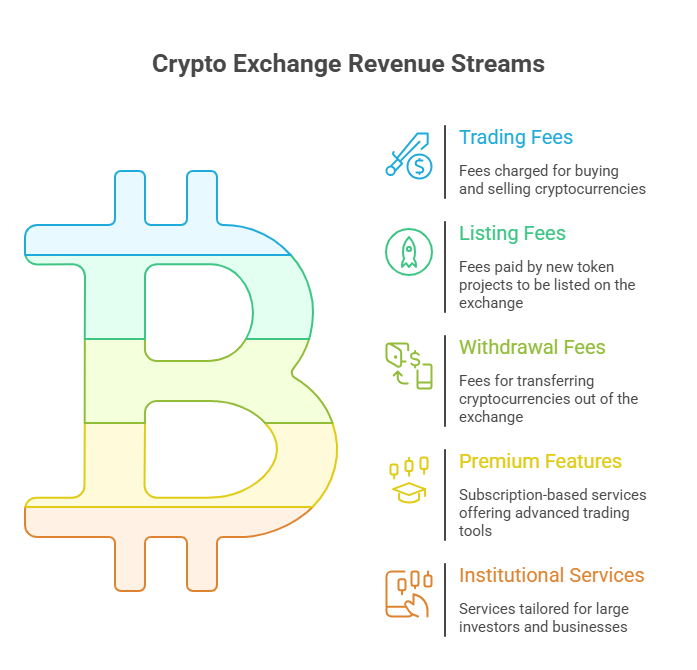
As the market matures, the opportunity is no longer limited to adopters. However, it is essential to choose the right business model and build diversified revenue streams that can support long-term growth and scalability.
Crypto exchanges typically generate revenue through:
- Trading fees using maker and taker models
- Listing fees charged for new token integrations
- Withdrawal and transaction fees
- Premium trading features and subscription plans
- Institutional services and API access
Offering multiple revenue streams not only improves profitability but also strengthens the long-term stability of your crypto exchange.
Common Mistakes When Starting a Crypto Exchange
There are technical, operational, and regulatory hurdles to launching a crypto exchange. Avoiding the following mistakes can greatly increase your chances of long term success.
Ignoring Regulatory Compliance
Failing to comply with KYC, AML, licensing, and reporting requirements can lead to legal issues, penalties, and restrictions on business operations.
Launching Without Liquidity
Even the most advanced exchange will have a hard time without enough liquidity. Poor liquidity means wider spreads, slower order execution and a poor trading experience.
Weak Security Implementation
Poor security practices can leave the platform vulnerable to cyber attacks and asset theft. Cold storage, encryption, multi-factor authentication, and regular security audits are a must.
Poor User Experience
Complex onboarding, a confusing interface, and slow platform performance can frustrate users and lead to poor customer retention.
Poor Scalability Planning
Most exchanges are not designed to support growth. The exchange needs to be able to accommodate growing levels of users, transaction volume and new features for traders.
Lack of Marketing Strategy
Building the exchange is only the first step. Attracting users requires a strong marketing strategy that includes SEO, community building, referral programs, and strategic partnerships to drive growth and long term adoption.
Choosing Inexperienced Development Partners
Developing a crypto exchange requires a high level of experience related to blockchain solutions, security, compliance, and financial systems. If you work with an inexperienced development team, you are taking risks, increasing cost, and lengthening your time to market.
Accelerate Your Crypto Exchange Launch with Softean
Building a crypto exchange is often more than just a simple development project. It is a complex engineering task that requires deep expertise in blockchain, infrastructure, and financial technology.
Softean works with businesses to design and build cryptocurrency exchange platforms that are:
- Architected for scalability and performance
- Designed with security-first principles
- Integrated with modern blockchain ecosystems
- Built to support real-world operational demands
Our team at Softean has years of experience building efficient, ready-to-launch crypto exchanges. We treat clients’ exchange platforms as long-term infrastructure that needs to be scalable from day one, helping businesses launch, run, and grow with confidence.
Frequently Asked Questions
Is starting a crypto exchange profitable?
Yes. Successful exchanges make money through trading fees, listing fees, withdrawal fees, staking commissions, and premium trading products.
How long does it take to build a crypto exchange?
In general, a fully customized exchange takes 4 to 9 months depending on the complexity.
What is the minimum budget needed to start a crypto exchange?
You can start a basic exchange with $50,000 to $100,000 or more, and an enterprise platform usually costs $250,000 and up.
What security features should a cryptocurrency exchange have?
Multi factor authentication, cold storage, encryption, DDoS protection, fraud monitoring, security audits, multi signature wallets, etc. are necessary.
Can I launch a crypto exchange globally?
Yes, though the requirements for compliance vary by jurisdiction. You’ll need to get proper licenses and legal counsel to expand.
Centralized vs Decentralized Exchange: Which One Is Better?
Centralized exchanges offer higher liquidity and better user experience, while decentralized exchanges provide more transparency and user control over assets.
Conclusion
A crypto exchange succeeds when the whole system is well designed and works smoothly, not just because of its individual features.
If you manage development in-house or use several vendors, you can end up with gaps between key parts like the trading engine, wallet, liquidity, and security. These problems might not show up at first, but they can quickly hurt your platform’s performance, growth, and user trust after launch.
The main challenge is not figuring out what to build, but making sure all parts work together as one reliable system when real trading starts.
This is why choosing the right technology partner can make a big difference.
Softean offers complete cryptocurrency exchange software development services, taking care of everything from system design and backend work to blockchain integration, security, testing, and launch. Instead of juggling different teams, you get a single, unified platform that is ready for real trading.
If you want to launch a crypto exchange, it’s best to start with a clear and organized plan.
Reach out to Softean’s experts to help you build your exchange from start to finish, so you can move forward with confidence.